Koert Lindijer has been a correspondent in Africa for the Dutch newspaper NRC since 1983 to 2026. He is the author of four books on African affairs.
Certainly, Israel’s recognition has made us enemies, says Somaliland President Abdirahman Mohamed Abdullahi at his official residence in the capital, Hargeisa. Abdullahi, just back from Dubai, looks somewhat weary after a diplomatic trip to the Gulf region. “The terrorists of Al-Shabaab [the jihadist movement in the Horn of Africa] issued a fatwa against me yesterday, and Somalia is threatening an invasion.”
Israel’s recognition of the self-declared Republic of Somaliland in northwestern Somalia came completely unexpected at the end of December. The decision is controversial because it calls into question both the territorial unity of Somalia and the African principle of inviolable borders. Somalilanders, for their part, are still ecstatic, as if their nation has finally been liberated.
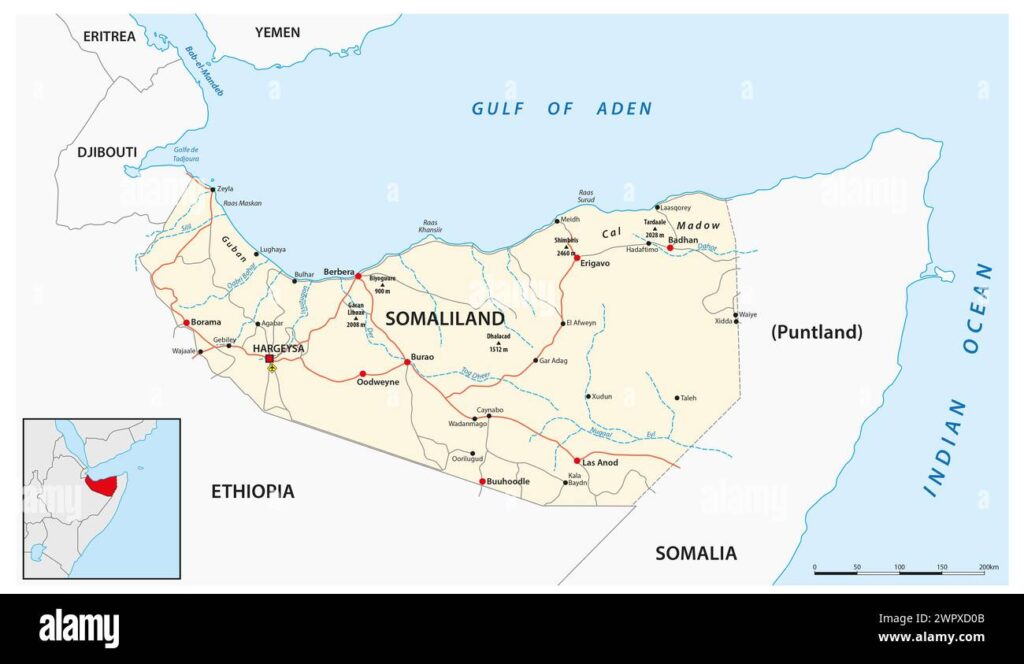
The former British protectorate of Somaliland declared independence from Somalia, which was in 1991 mired in military chaos, but no nation recognized that status. Officially, Somaliland did not exist. Until Israel stepped in. The international reaction was one of anger. Somali President Hassan Sheikh Mohamud accused Israel of destabilizing the Horn of Africa. The country also allegedly wants to dump Palestinians in Somaliland and attempt to establish a military base there.
Such a military base near the port city of Berbera would give Israel a bridgehead along the Red Sea, a crucial route for international trade and energy. Officially, Jerusalem espouses the right to self-determination and stability in the Horn of Africa, but strategically, a base would position Israel closer to Yemen, where the Houthis repeatedly fire rockets into Israel in solidarity with the Palestinians.
The African and European Unions, the Arab League, and the UN condemned Israel’s recognition. Turkey and Saudi Arabia, allies of the Mogadishu government, launched a diplomatic offensive against the recognition. Mohamed Abdullahi rejects Mogadishu’s criticism. “We didn’t offer Israel military bases along the Red Sea, and they will not be dumping Palestinians here.”
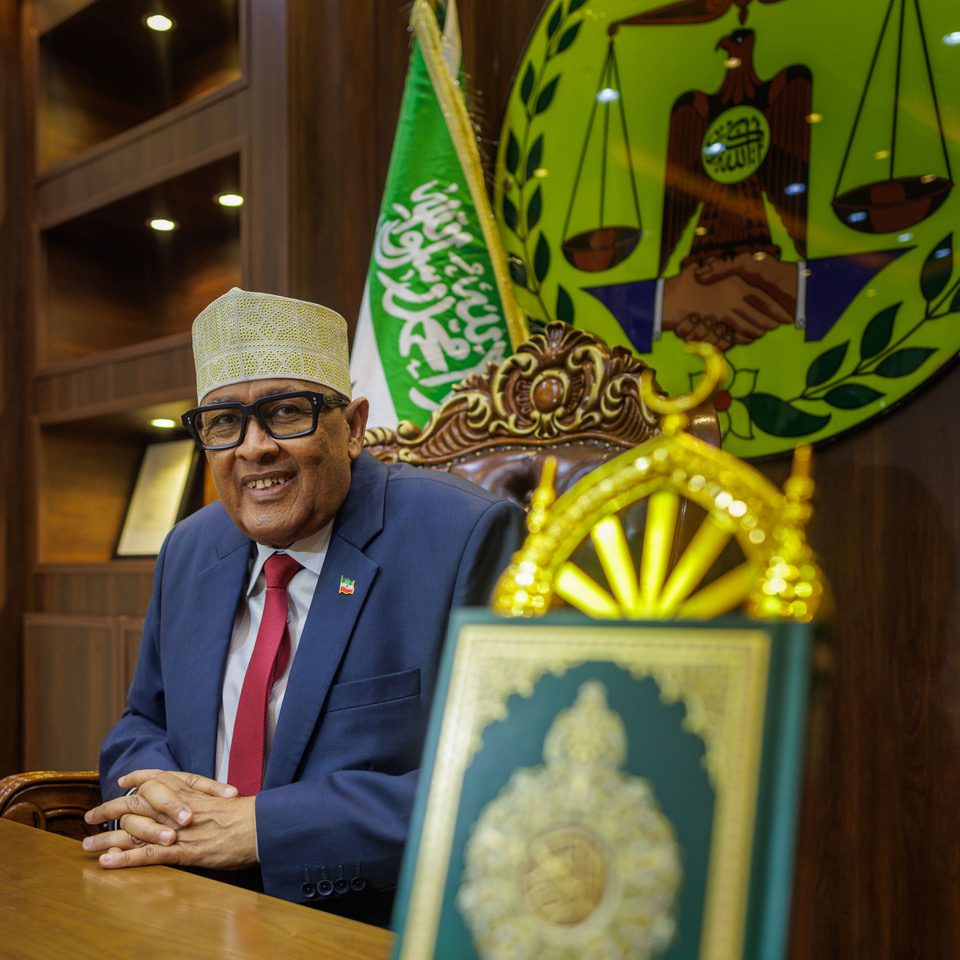
Somaliland President Abdirahman Mohamed Abdullahi
Behind the scenes, Somaliland is looking beyond Israel. A minister told AFP that the country is prepared to grant the United States exclusive access to raw materials and military facilities. The goal: broader international recognition.
Foreign Minister Abdirahman Dahir Adam puts it less diplomatically. “They can go to hell,” he says of the countries challenging the Israeli decision. “Nothing is worse than the situation we’ve been in since 1991. We didn’t know what to do anymore.” He expects several countries to follow Israel’s example. “We are negotiating recognition with several countries, and more will come forward,” he predicts, without being specific. “Somaliland is now a reality; thanks to Israel, there’s no turning back.”
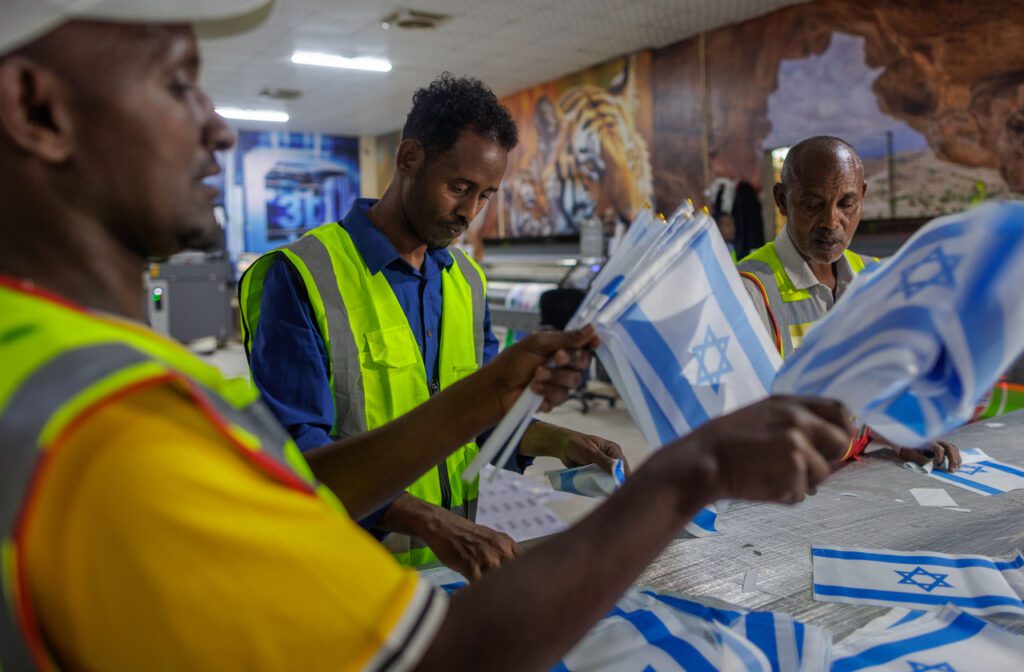
Israel’s recognition didn’t come easily: Seven politicians secretly negotiated with Jerusalem, and by the end of December, rumors were buzzing about a possible recognition of Somaliland. “At first, we didn’t know which country it was,” says Abdi Yusuf, owner of the Segaljet printing company in Hargeisa. “So, we had to quickly look up the correct flag online [when it became known that it was Israel]. Within half an hour, the presses were running. Long lines had formed in front of our company, and in no time, we had sold ten thousand Israeli flags.”
The streets of Somaliland’s capital, Hargeisa, were filled with jubilant residents waving Israeli flags. In their euphoria, the Islamic country seemed to temporarily set aside all its abhorrence of Israel over the war in Gaza. “I quickly deleted all my tweets about the genocide in Gaza,” laughs Sahra Jibril, owner of a camel farm. “But now we urgently need recognition from another, less tainted country.”
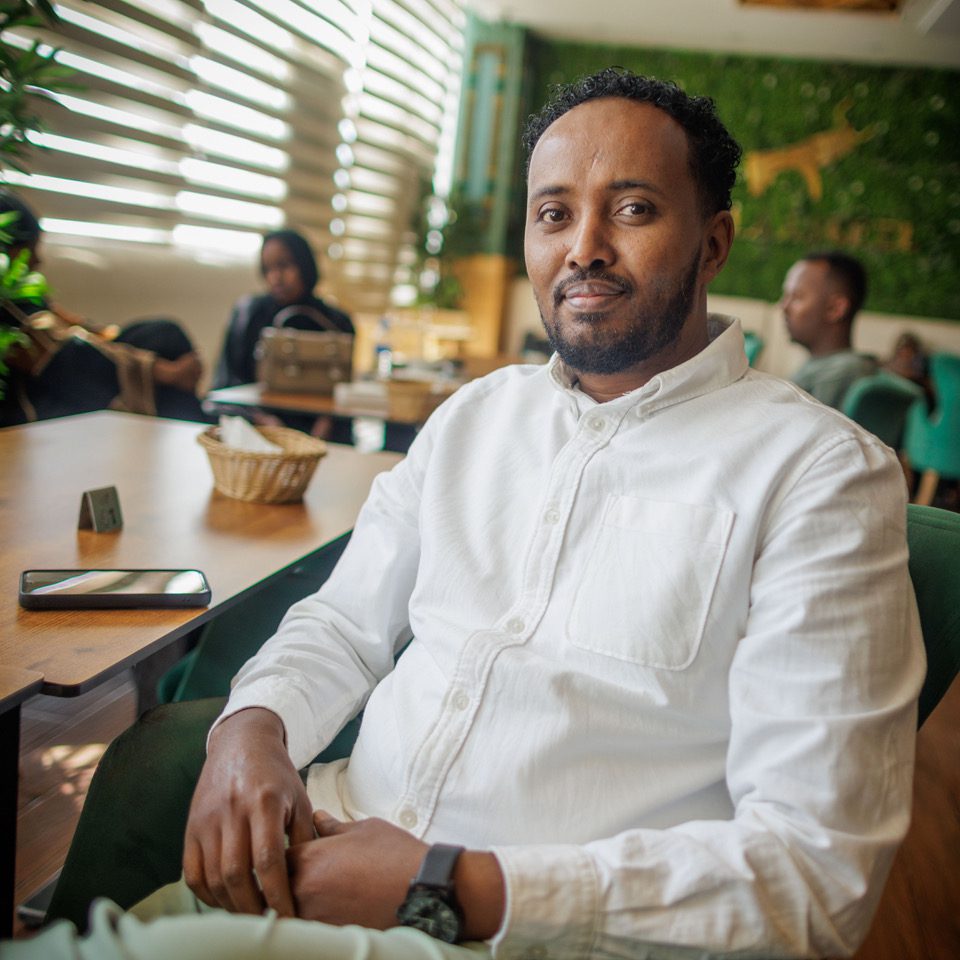
Businessman Abdulaziz Awil
Hypocritical, say Somalilanders, is the criticism that you shouldn’t establish relations with a country waging a genocidal war against Palestinians in Gaza. “Why does everyone mention the genocide in Gaza, but no one mentions the genocide against us in 1988?” asks businessman Abdulaziz Awil. “When recognition came, we Somalilanders didn’t think about Gaza, only about ourselves.”
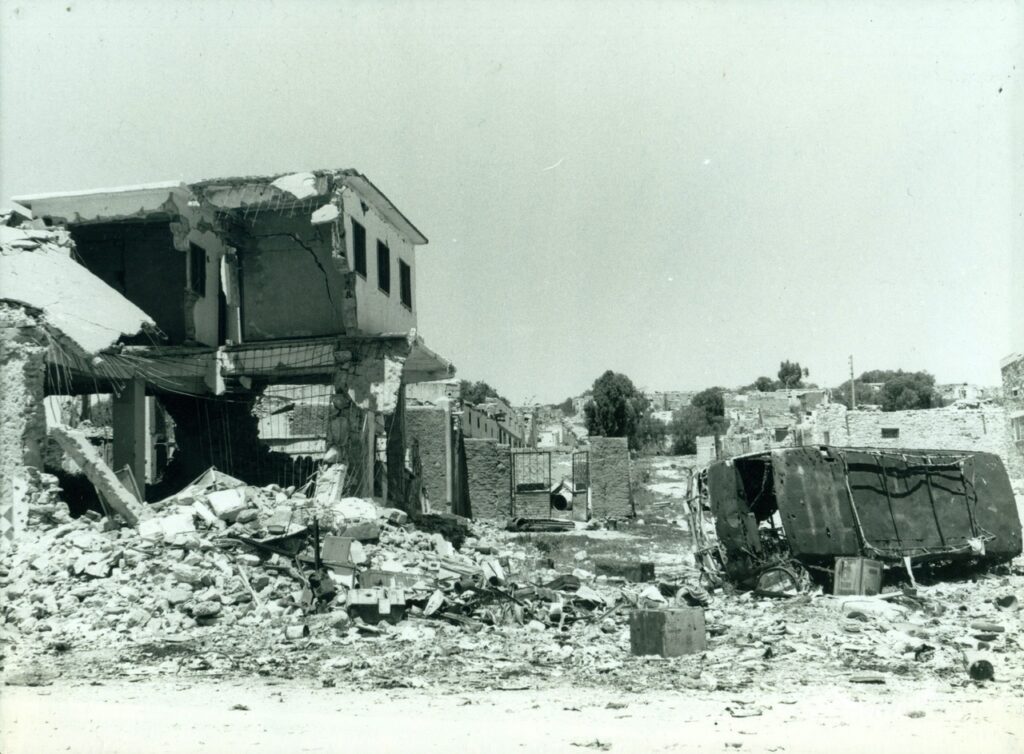
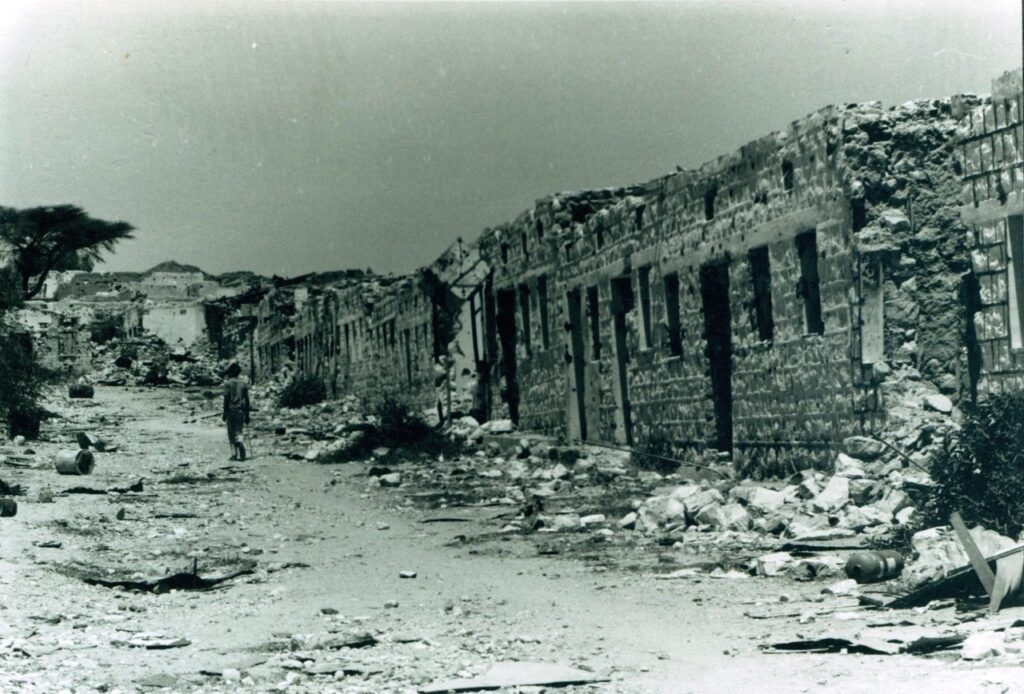
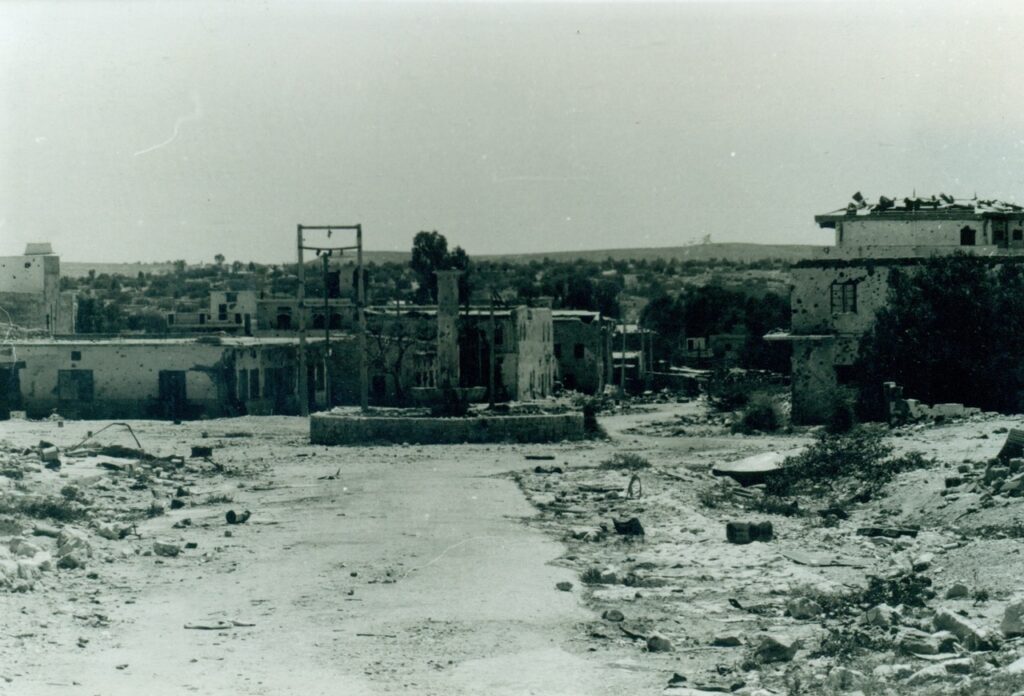
Awil refers to the violence in 1988, when the Somali army almost destroyed Hargeisa. In the northwest, the area that forms Somaliland, an estimated 200,000 people were killed and hundreds of thousands fled. Since then, many residents have permanently turned their backs on Somalia.
That is why the authorities in Hargeisa are not talking about secession from Somalia. “There never was a Somali nation, only five Somali-inhabited areas in the Horn, in Djibouti, Kenya, and Ethiopia,” says Minister Dahir Adam. “Somaliland voluntarily joined Somalia in 1960, when it gained independence from Italy. Now we are taking back our independence.”
There is still much bitterness among Somalilanders about the events of 1988. The uncle of Rooble Mohamed, a resident of Hargeisa, died in his arms during the 1988 bombing. “No one stood up for us during that genocide, and now they want us to be politically correct. We lived in isolation for thirty-five years. Now I want my children to study in Israel. Recognition means that we can travel again, do business with foreign partners, and send our sick abroad for treatment.”
The Somalilanders’ legal arguments for recognition are clear. Somaliland has held six fair and uncontested elections since 1991 and is stable compared to Somalia. Despite the billions the international community has spent on peace and reconstruction, the neighboring country is still considered a failed nation due to the limited authority of the central government and the persistent violence.
Somaliland has largely kept the Al-Qaeda-affiliated Al-Shabaab outside its borders. Compared to Al-Shabaab’s constant attacks and territorial control in Somalia, many Somalilanders experience their region as a rare island of order in the unstable Horn of Africa.
“Human rights are respected here more than in any other country in the region,” says Guleid Ahmed, a lawyer formerly affiliated with the Human Rights Centre, a human rights organization in Somaliland. “There are no abductions of dissidents or torture.”
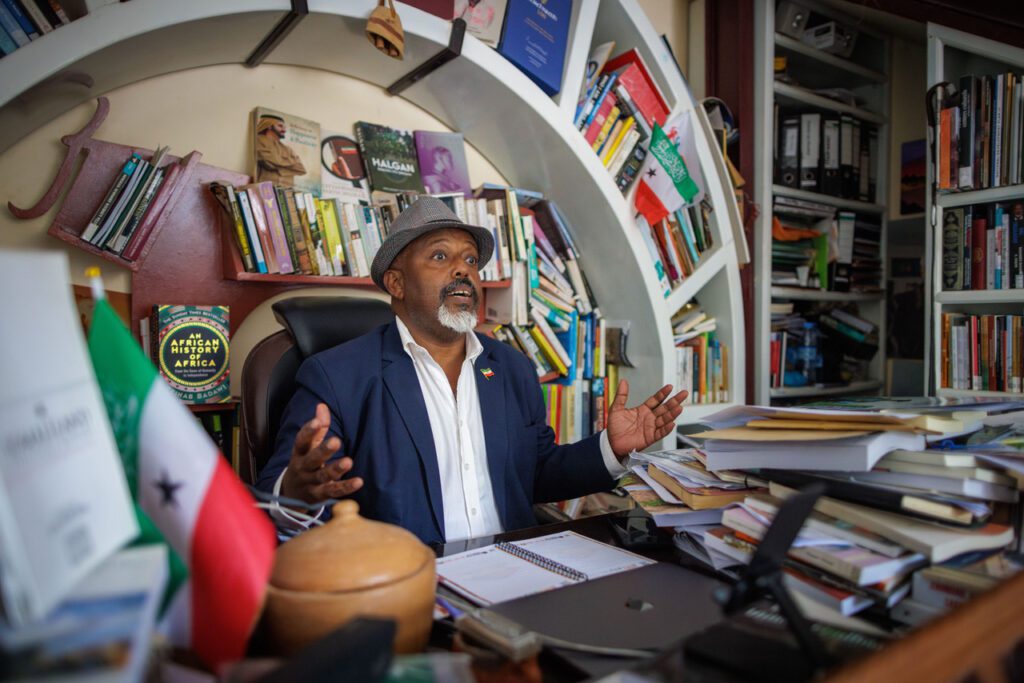
Jama Musse Jama sits surrounded by books in his cultural center in Hargeisa.
Jama Musse Jama sits surrounded by books and posters of Somaliland poets in his cultural center in Hargeisa, in which every year he organizes an international book festival. He points out the psychological importance of recognition. “Hope has returned. Immediately after recognition, imams in mosques preached fiercely against Israel, but young people silenced them. Now the imams are silent; they don’t want to go against the tide. Every Somaliland citizen supports the Israeli decision. The younger generation could no longer tolerate our isolation, wanted to be part of the world, and became restless.” Armed Islamist groups, such as Al-Shabaab, active in Somalia, can benefit from this unrest. Their ideology has gained increasing traction. “If you don’t have a national identity, if you can’t rely on a nation, you are vulnerable to the ideology of armed Islamism. I feel threatened.”
Maybe we chose an ugly partner, say Somalilanders, but we need friends. Abdirahman Mohamed Abdullahi shrugs off all the criticism of the Israeli decision. “They’re using it as an excuse against us,” says the president of Somaliland. “Some countries don’t want to recognize us anyway. Not at all. So, whether it’s Israel or the Netherlands, they will oppose it. Israel’s recognition is in our interest; every nation pursues its own interests.”
This article was first published in NRC on 24-2-2026
Pictures above by Petterik Wiggers, pictures below by Koert Lindijer, taken in 1991 of what remained of Hargeisa