In June, Kenya has started a 13 million euro programme to compensate the victims of police brutality during political unrest that took place between 2017 and 2025. But families of the victims are calling for trials.
By Martina Jebet in Nairobi, Kenya
Rex Masai left home on the morning of 20 June 2024 carrying a water bottle, a Kenyan flag, and the conviction that young people had a right to be heard. The 29-year-old had joined nationwide demonstrations against the Finance Bill, protests fuelled by anger over rising living costs, corruption and a political class many young Kenyans felt no longer represented them. By evening, the young man was dead, struck by a live bullet, as crowds dispersed in Nairobi’s central business district.
His mother, Gillian Munyao, remembers him as the eldest son who dreamed of becoming an architect, but, when the family could no longer afford university tuition, he took a job at a Nairobi casino, saving to educate his younger siblings. “My daughter still cries,” Munyao says. “She tells me, ’Mum, my dream died with Rex’.”
Two years later, Munyao finds herself feeling ambivalent. The government that failed to protect her son now wants to compensate his family through Kenya’s first national reparations programme for victims of recent protest-related violence. But acknowledgement from the state, she says, cannot substitute justice. “There is no human life worth three million shillings,” she says. “First let those responsible be judged, then come and tell us about the money; the money can only wipe away tears.”
IMPUNITY OF THE SECURITY FORCES
So far as the Treasury begins disbursing payments, the Independent policing oversight authority (IPOA) and the Office of the director of public prosecutions have secured zero convictions in connection with the protest-related deaths from 2024.
In fact, according to human rights organizations, Kenyan authorities have not investigated or prosecuted security forces, in most cases of excessive and lethal force during protests from 2023 to 2025. A joint report by Human Rights Watch and Amnesty International Kenya found that at least 31 people were killed during the 2023 cost-of-living protests. In 2024, the IPOA said it had registered 60 killings, while 26 people abducted by the police are still missing. And according to Amnesty international Kenya, in June and July 2025, 65 deaths and 341 injuries were recorded by the IPOA. The Kenya National Commission on Human Rights separately recorded 57 deaths and at least 531 injuries in the same period.
Arrests also reached alarming levels: the IPOA recorded 760 arrests in July 2025, the peak single-day arrest figure for 2025. In 2026, the anti-fuel-hike protests on 18 May produced the highest single-day arrest count recorded so far, with 1058 arrests reported. A further 355 arrests were reported on 25 June 2026.
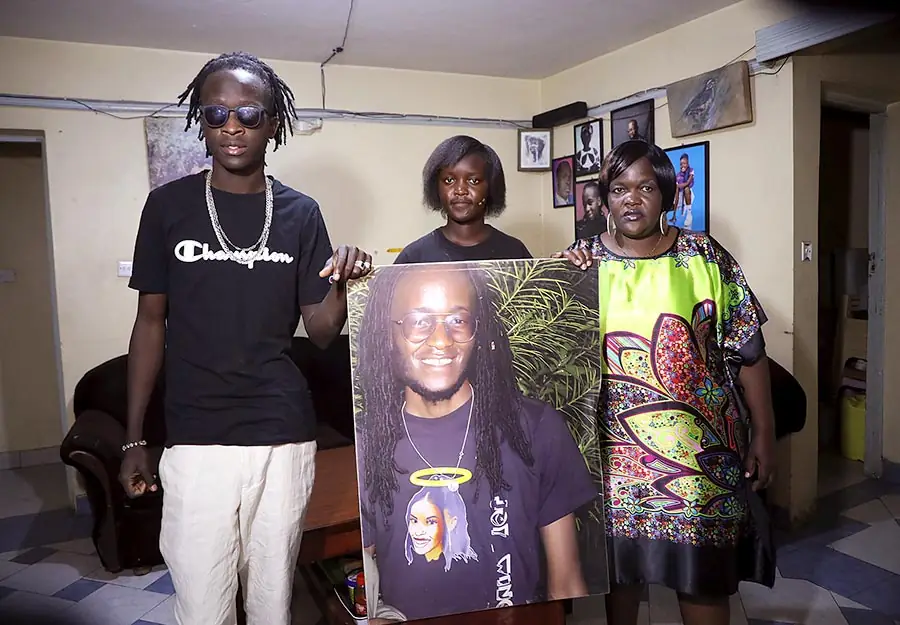
Masai (in portrait) left his home on the morning of 20 June 2024 to join large-scale protests against a draft finance bill. By the evening, the young man was dead. Instead of the justice they had hoped for, his younger brother, his sister and his mother (from left to right) are now set to receive compensation from the Kenyan government. Photo: © Martina Jebet
HOW KENYA’S REPARATIONS PROGRAMME WORKS
Kenya has set up a 2 billion Kenyan shillings (KSh) fund (roughly €13 million): it is the first time the government has set aside money to compensate victims of police brutality during recent political unrests. The fund is meant to cover four periods of violence: the 2017 post-election protests, the 2022 post-election period, the 2023 Maandamano demonstrations, and the youth-led protests of 2024–25.
Irũngũ Houghton, former executive director of Amnesty International Kenya, traces the programme’s origins to the National dialogue committee established after the disputed 2022 presidential election. “The opposition, led by its party leader, Raila Odinga, organised a series of nationwide protests in 2023 that ended in violent clashes with police; this prompted President William Ruto and Odinga to agree to a political truce,” Houghton says. “The National dialogue committee was established to help mediate a political settlement, and its recommendations included reparations and compensation for victims of human rights violations and police brutality during public protests.”
The government says 1,101 verified victims out of 1,815 total claims reviewed will benefit, including families of those killed, survivors of permanent or minor injuries, victims of aggravated sexual violence, and individuals who suffered property destruction. However, 35 verified families of the disappeared and 135 torture survivors remain excluded from initial payouts, pending stricter verification.
RE-EXAMINATION AND RE-TRAUMATISATION FOR VICTIMS
“Subjecting families of the disappeared and torture survivors to a secondary state scrutiny is an unlawful, discriminatory barrier that inflicts fresh trauma on families,” says Abner Collins Mango, lead counsel for the Coalition of victims and survivors against state violence. He argues that the government-appointed task force has no legal power to alter or disregard the reparations framework established by the Kenya National Commission on Human Rights.
As for the payouts, they vary by category. Families of those killed are expected to receive KSh 3 million (€20,312) each: it’s this figure Munyao mentions when rejecting the idea that a payout can settle her son’s death. Survivors of torture, detention, and permanent injury fall into separate, lower bands.
Houghton calls the programme a meaningful step, noting that victims deserve recognition without having to wait years for court proceedings, but he also believes the government should not treat compensation as the end of justice. Reparations, he argues, address the aftermath suffered by victims, the loss, injury, and trauma, while accountability addresses the crime itself by identifying and punishing those responsible. “If a state pays financial compensation without punishing the individuals responsible, it treats human rights violations as an operational cost rather than a crime,” he says. “That allows abusive behaviour to continue unchecked.”
This story was first published by the Conversation