

Newsflash:
The Rapid Support Forces (RSF) and Sudan People’s Liberation Movement – North (SPLM-N) forces captured the town of Kurmuk in southeastern Blue Nile State yesterday, 23 March 2026, scattering army units, plundering supplies and equipment, and taking prisoners, including senior army officers. The development marks the first major success of the RSF and SPLM-N since they formed an alliance last year and jointly activated a new front in Blue Nile. The rebel offensive is supported from Ethiopia’s Benishangul-Gumuz region, where the RSF and SPLM-North established a training camp and logistics hub last year, allegedly with covert assistance from the United Arab Emirates.
There have been a lot of speculation that soon a new war may start in Northern Ethiopia, this time with the same players as in the last war around Tigray, but in different alliances. However, the impact of the Iran war has been deeply felt in Ethiopia and prime minister Abiy Ahmed may not find the time opportune to start another war. Increasing attacks by the RSF in recent days coming from camps in western Ethiopia threaten to make the Sudan civil war join with the civil strife in Ethiopia.
The focus should now be on eastern Sudan.
By Mat Nashed
The prospect of renewed war in northern Ethiopia between government forces, Tigray factions, and Eritrea risks pulling in neighbouring Sudan and merging two of the deadliest conflicts in recent history.
After fighting a war against Tigrayan forces from 2020 to 2022, the Ethiopian government may be on the verge of resuming hostilities to consolidate control over the country’s northernmost region.
It is also increasingly threatening Eritrea. Ethiopia fought alongside Eritrea during the Tigray war but is now signalling it may seek to invade to regain direct access to Red Sea ports lost when its northern neighbor gained independence in 1993.
A new conflict could lead to large-scale loss of life in Ethiopia and Eritrea while also triggering a messy, protracted regional crisis, potentially pulling in Sudan, given its military-led government’s fraught relations with the Ethiopian state.
“I can imagine a scenario where Sudanese actors are mobilising to support their preferred partner in Eritrea or Ethiopia,” said Michael Woldemariam, an associate professor at Maryland University. “We could begin to see a one-conflict ecosystem.”
The Sudanese Armed Forces (SAF), the national army, is fighting a brutal civil war against the paramilitary-turned-rebel Rapid Support Forces (RSF), which is accused of genocide crimes, ethnic cleansing, and shocking levels of sexual violence.
Recent reporting has found that Ethiopia is allowing the RSF to use its territory for a covert training camp. Meanwhile, the SAF is formalising ties with Tigray factions and Eritrea to form a front against Addis Ababa if a new war breaks out.
Analysts said the SAF could directly send supplies to Eritrean and Tigrayan forces in the event of a war, or that militias in eastern Sudan with ties to Eritrea could enter the fray of their own accord.
Ethiopia could then respond by expanding its support to the RSF, with the help of the United Arab Emirates (UAE), the chief regional backer of both Addis Ababa and the RSF. Arab states opposed to the UAE’s aggressive foreign policy could be pulled in too.
Alan Boswell, an expert on the Horn of Africa for the International Crisis Group, said the entire region is at risk of erupting due to these overlapping, entangled rivalries and alliances.
“We are in an incredibly dangerous situation, where both sides (Ethiopia and Sudan) view the other as actively helping their armed opponents,” Boswell said. “All the ingredients are there for a much wider regional blow up – really, a regional mega-war.”

Expansionist rhetoric
The last war in northern Ethiopia erupted amid tensions between Addis Ababa and the Tigray People’s Liberation Front (TPLF) – the ruling party in Tigray and the dominant force in Ethiopian national politics until Prime Minister Abiy Ahmed took office in 2018.
A 2022 ceasefire accord ended the fighting, but tensions between Abiy and TPLF leaders have been growing, and Tigrayan civilians have struggled to recover from the atrocities, ethnic cleansing, and siege campaign carried out by the Ethiopian army and its allies, which may have killed up to 600,000 people.
In January, clashes broke out between the Ethiopian federal army and Tigrayan forces in two Tigrayan districts. The federal government then moved several army divisions towards the Tigray border.
The sharply escalating tensions between Ethiopia and Eritrea, meanwhile, mark a reversal from a 2018 peace deal that ended two decades of intermittent conflict between the countries, as well the wartime alliance against the TPLF.
Eritrea was critical of the 2022 treaty, but relations with landlocked Ethiopia plummeted over Addis Ababa’s push for sea access, particularly after Abiy signalled Eritrea’s Red Sea port of Assab as a possible option to take over.
“Abiy believes Ethiopia should be a regional hegemon and that he can rectify the historical mistake of giving up sea access to Eritrea,” said Goitom Gebreluel, a regional expert and a visiting fellow at the London School of Economics (LSE).
Against this backdrop, Eritrea shifted its posture from fighting the TPLF – with whom it had a decades-long enmity – to allying with a faction led by Debretsion Gebremichael, which de facto controls much of Tigray.
Sudan is already entangled in this regional power struggle, with the SAF backed by Eritrea and TPLF fighters while facing pressure from Ethiopia’s support of the RSF, which has enabled the group to open a new front in Sudan’s Blue Nile state.
Compounding tensions, the SAF-backed Sudanese government in Port Sudan claimed in early March that drones were fired from Ethiopia against SAF targets, raising the temperature between the two countries.
There are also longer-standing tensions around disputed territory between Sudan and Ethiopia, and around an Ethiopian dam project that Sudan and other downstream countries feel threatens their water security.
If Sudan becomes involved in a new war in and beyond Ethiopia’s north, attention is likely to turn to the thousands of Tigrayan fighters who reportedly fled to eastern Sudan’s Gedaref state during the 2020-2022 conflict.
Among these forces are well-trained Tigrayan fighters who claimed asylum in Sudan after serving as UN peacekeepers in the disputed area of Abyei, between Sudan and South Sudan.
“This area – around Gedaref – could be used as an operation base to plan attacks against [Ethiopia],” said El-Tagani el-Haj Abdelrahman, a Sudanese researcher and the author of a recent report on conflict dynamics in eastern Sudan.

The militias of eastern Sudan
Sudan could also become embroiled in the conflict through communities in the east with strong ties to Eritrea and a longstanding animosity toward Ethiopia’s federal government.
“There are tribal constituencies in eastern Sudan that could get pulled into a broader war [with Ethiopia], turning it into a cross-border [conflict] by nature,” said Woldemariam of Maryland University.
Since winning independence from Ethiopia following three decades of armed struggle, Eritrea has maintained close relations with militias in eastern Sudan, going so far as hosting them when they were fighting the Sudanese government.
Since the outbreak of Sudan’s civil war, Eritrea has again been hosting and training eastern militias with the SAF’s consent, primarily to protect their frontier from an RSF incursion, according to the report by El-Haj Abdelrahman.
The report states that Eritrea is particularly supportive of militias from Sudan’s Beni Amer and Habab communities, which speak Tigre – a language shared by Tigre communities in Eritrea, which make up around 30% of the population.
El-Haj Abdelrahman said many Beni Amer in eastern Sudan feel a close affiliation with the Beni Amer and Tigre in Eritrea and would likely help Eritrea and its allies fight against Ethiopian federal forces.
The early phase of Eritrea’s independence war drew heavily on Beni Amer and Tigre fighters, and though relations between these communities and President Isaias Afwerki have long been strained in both Eritrea and Sudan, the historical enmity with Ethiopia persists, according to El-Haj Abdelrahman.
“For the Beni Amer, Ethiopia are their historical enemies… so they will fight with Isaias against Abiy,” he said.

Could rival Arab powers join the fray?
If Sudan does become involved in a conflict, analysts said Abiy could retaliate by further backing the RSF and its ally, the Sudan People’s Liberation Movement-North (SPLM-N), a rebel group, in their fight against the SAF.
They said the RSF could also potentially use long-distance drones to target supply lines stretching from Port Sudan into Eritrea or Tigray.
Gebreluel, from the LSE, said the RSF is dependent on Ethiopia and the UAE and “will do anything it can for Ethiopia” if it goes to war. “It just depends on their capacity and whether or not they will be stretched too thin,” he added.
Beyond Sudan, analysts said a worst-case scenario could also see an Ethiopian offensive on Eritrea directly pull in rival Arab powers, especially given current tensions between the UAE – Addis Ababa’s primary backer – and Saudi Arabia and Egypt.
While the UAE is currently focused on intercepting Iranian drones and missiles, its broader perception of security is linked to sea ports in Africa. Two of its national companies manage over a dozen ports on the continent.
The SAF, Saudi Arabia, and Egypt, consider Ethiopia’s quest for a Red Sea port as serving the UAE’s geopolitical security interests at the expense of their own, according to media reports and analysts.
The trio view the UAE as undermining regional stability and their national security by backing violent armed groups in Yemen and Sudan, including the RSF.
The UAE has used its access to the port and airport in Bosaso, in Somalia’s semi-autonomous Puntland region, to transport weapons to RSF units in Darfur via eastern Libya.
The shipments helped the RSF capture North Darfur’s capital of el-Fasher in October – an offensive culminating with the mass killing and ethnic cleansing of local communities.
To counter the UAE’s influence, rival Arab states could funnel weapons through eastern Sudan to help Eritrean and Tigrayan forces fight Ethiopian federal troops, especially if the port of Assab is attacked.
“Any new conflict [in the Horn] is bad, but one where you see Eritrea pulled in is where you could see the activation of a broader constellation of actors,” warned Woldemariam, the expert from Maryland University.


The human cost
The human cost of a regional war in the Horn of Africa would of course be catastrophic.
Tigray still hasn’t recovered from the previous conflict, which saw government forces and their allies commit massive atrocities against civilians and carry out ethnic cleansing in Western Tigray.
“This isn’t a context where we have seen an end to cycles of forced displacement. It has continued as a result of fighting and abuses,” said Laetitia Bader, the Horn of Africa director at Human Rights Watch.
With violence simmering, Woldemariam said Tigrayan civilians can’t cope with another all-out conflict. The region is already dealing with a dire shortage of medications and ruptured livelihoods.
“It would be quite dire for the population to enter another war after coming out of one two years ago, in terms of their ability to manage the consequences,” he said.
Next door, Sudan remains the largest humanitarian crisis in the world. The conflict has uprooted some 15 million people over the last three years, and left 21 million enduring crisis levels of food insecurity or worse, with some facing famine.
Many fear a regional war could worsen the humanitarian crisis by destabilising eastern Sudan, a region where civilians have been relatively better off compared to the rest of the country.
“It’s a very fragile situation in that neck of the woods,” said Woldemariam. “And I think [destabilisation] would be a really large burden for eastern Sudan to bear.”
This article was first published by the New Humanitarian
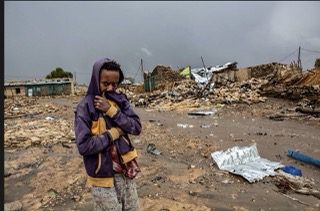
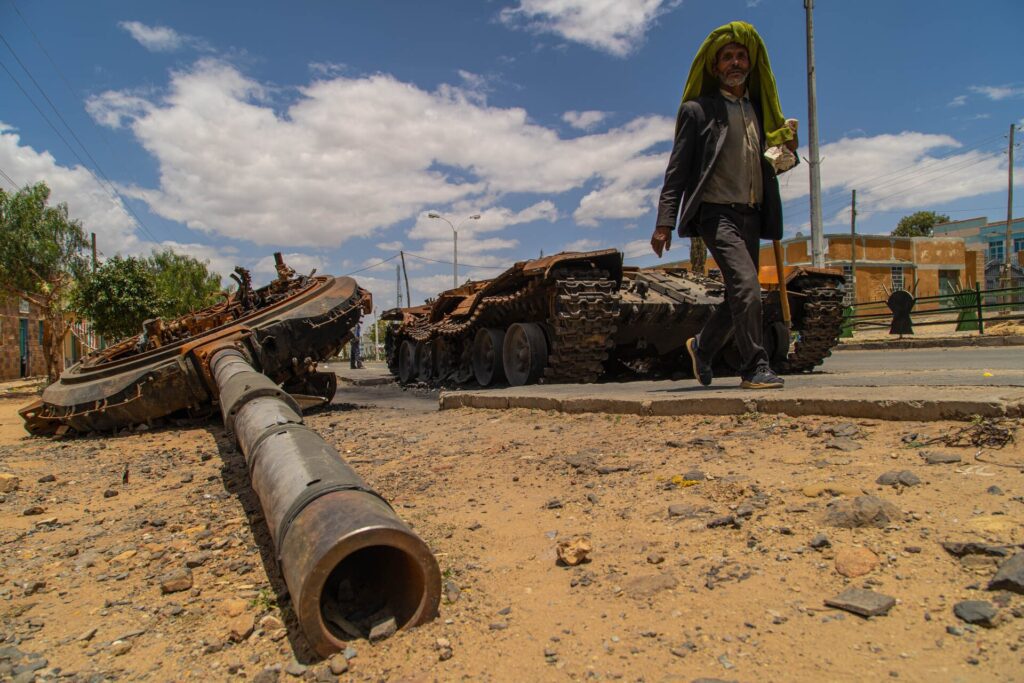
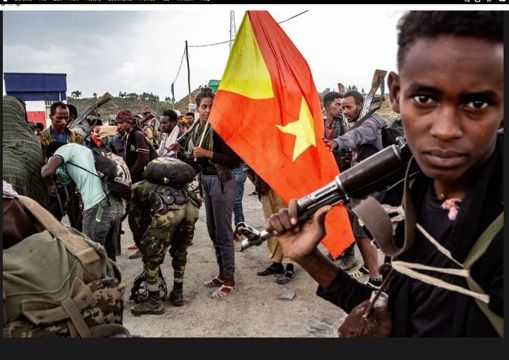
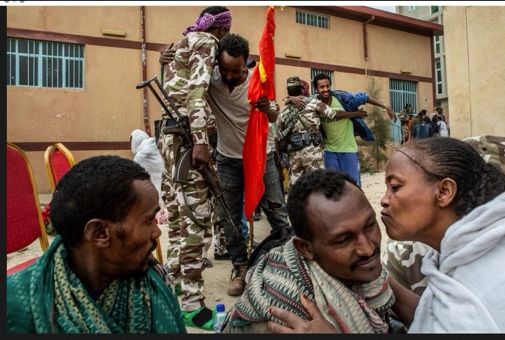
Pictures from 2021