

Kordofan and El Obeid have become the epicenter of fighting and suffering in Sudan
On an ordinary morning in El Obeid, Azza al-Amin kneads bread dough in her narrow kitchen as a drone buzzes angrily in the distance. She keeps working. Hundreds of people are counting on her.
Nearby, Mohammed Khaled, steers a tuk-tuk loaded with sacks of sorghum, heading from one side of El Obeid to the other. He knows the journey could end with a bullet – but stopping means dozens of families go hungry.
At the edge of town, Ahmed Abdelrahman, a truck driver, looks silently at the dirt road ahead as he prepares to leave El Obeid. He does not know what awaits beyond the first kilometre, but his mission to find supplies is too important to pass up.
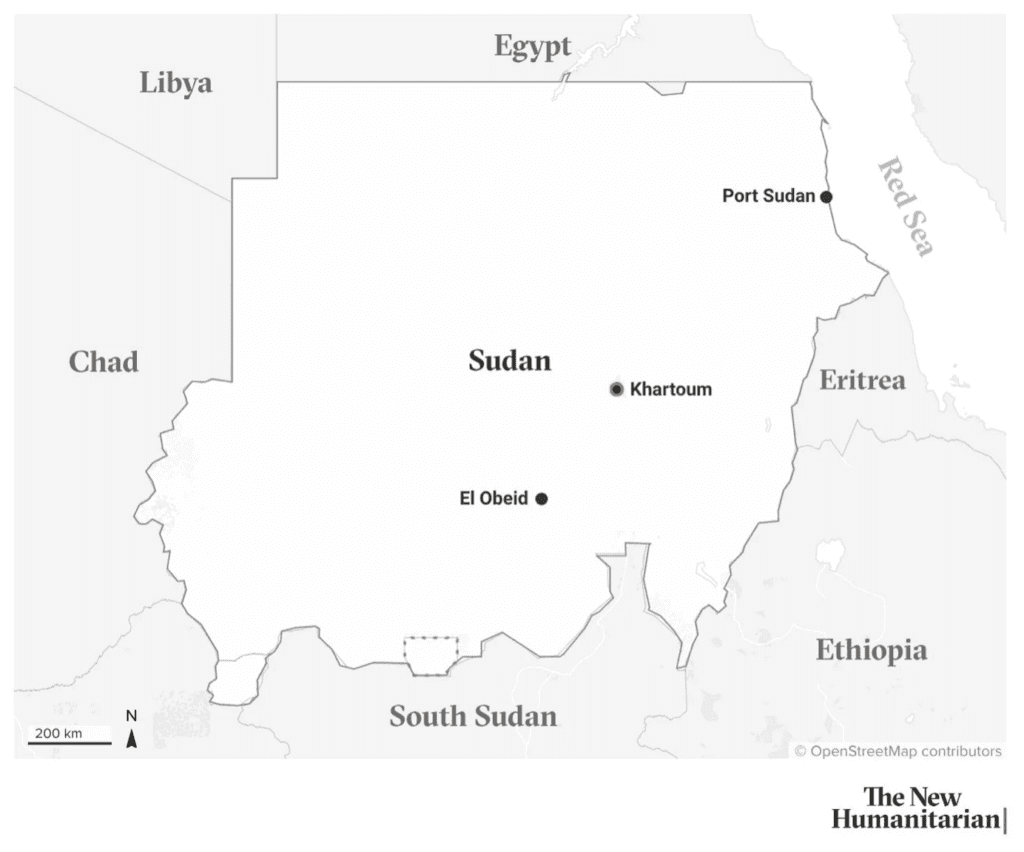
A vital crossroads city that connects the Rapid Support Forces-held Darfur region in the west with army-controlled areas in the east, El Obeid has been a flashpoint throughout Sudan’s three-year civil war, which has produced the world’s largest humanitarian crisis.
Home to a key army base, the city’s residents have endured drone attacks and a long-running siege imposed by the paramilitary-turned-rebel RSF, while taking in more than a million displaced people who are living in camps and with host families.

Yet far from giving in, the population has revived long-standing traditions of communal solidarity while reinventing other aspects of everyday life to survive the onslaught.
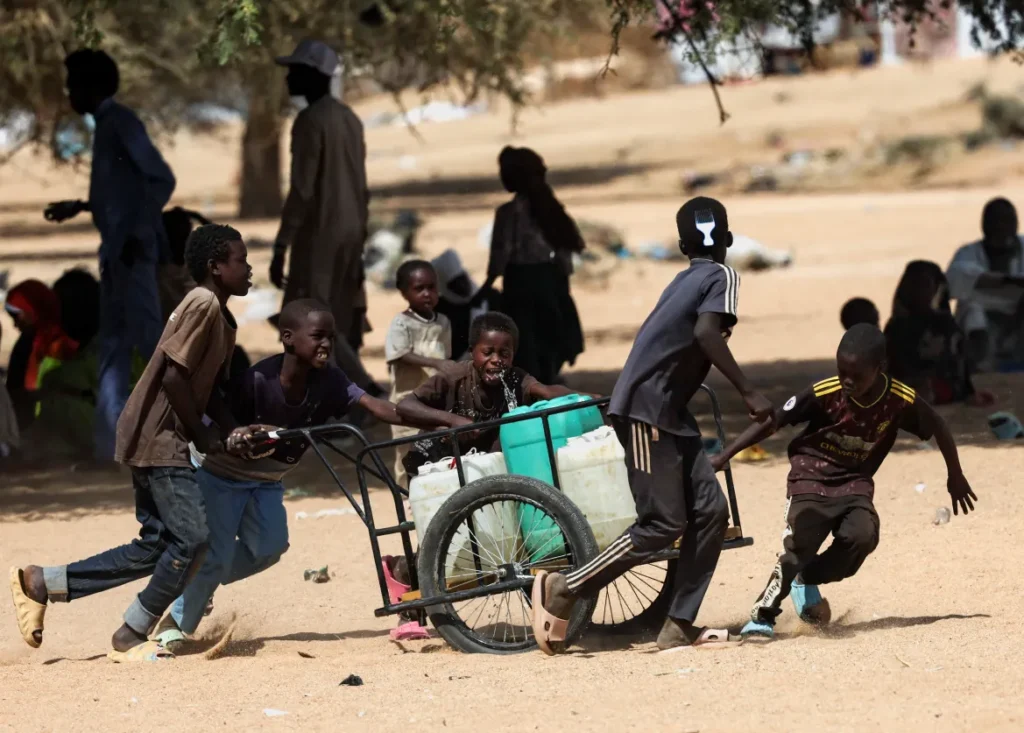
Across the city, host families have welcomed in the displaced, religious networks and volunteer groups have set up community kitchens, and small clinics and community-run health points have stood in for a struggling health system.
New local food production – largely led by women – has taken root to ease shortages, while truck drivers have risked their lives to bring in supplies, using back roads that pass through remote villages and forests to avoid armed checkpoints.
“We carry the lives of families, not just goods,” said 48-year-old Mohammed al-Hassan, one of many transporters who use cars, tuk-tuks, donkey carts, and sometimes their own backs to bring in goods. He said he views the work as a “duty rather than business”.
The efforts of El Obeid’s residents reflect a much wider story of local solidarity seen across all of Sudan’s states and cities for the last three years.
Yet residents said they remain deeply fragile – reliant on exhausted human effort and time. As al-Amin said: “We can make it through today… but tomorrow? Only if God is generous.”

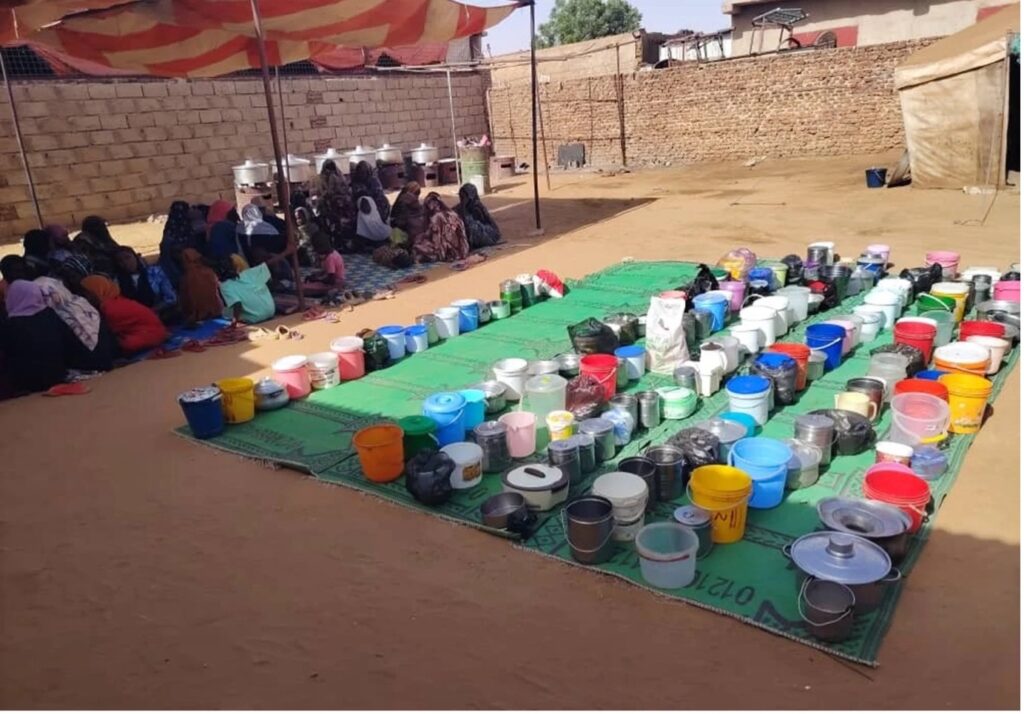
Abdel Fattah Makki Al-Daw/TNH A community kitchen in the Al-Radeef neighborhood of El Obeid, where residents have endured RSF drone strikes and siege warfare during the three-year conflict in Sudan.
“We are just people trying to help each other”
El Obeid lies in the Kordofan region, which became the epicentre of Sudan’s war last year after the RSF was driven out of Khartoum and other central regions. The group fell back into its western stronghold, leaving Kordofan as the new front line.
Though the army (the Sudanese Armed Forces, SAF) lifted an RSF siege last year, the rebels are present to the north – along the road linking El Obeid to Khartoum – and west, less than an hour from the city, which is neither fully cut off nor safely open.
The SAF-controlled city centre has become a key base for managing army operations in the region, transforming El Obeid into an open military barracks, with regular forces and allied militias spread across multiple positions.
The SAF presence has led the RSF to carry out drone strikes around the city, hitting markets, power substations, health facilities, and residential areas, causing mass casualties and repeatedly disrupting essential services.
El Obeid’s expansion from a pre-war mid-size town to a displacement epicentre has, meanwhile, placed a massive strain on health, food, and education services, and neighbourhoods and displacement camps have merged into a single urban space.
Humanitarian response in this context has evolved from a set of occasional acts of solidarity – mobilised for when there is a need – into a fully-fledged system of everyday life managed by the residents themselves.
With international aid dwindling and state support limited, residents say these multi-layered networks of solidarity now form the primary line of defense against hunger and breakdown.
Especially active are local responders from Emergency Response Rooms (ERRs), a decentralised network or neighbourhood-based mutual aid groups that have been set up across Sudan.
ERRs represent an emerging form of grassroots crisis management in El Obeid – coordinating food distributions, directing patients to medics, and linking communal kitchens together.
Al-Amin, an ERR volunteer, said her work consists of connecting dwindling neighbourhood resources to a wide map of needs – from overcrowded homes housing multiple families to displacement camps on the city’s outskirts.
Fielding a constant flow of distress calls, the ERR operates through loosely organised offices and committees supported by fluctuating donations from residents inside and outside the country, and from international aid organisations.
“We are not an organisation; we are just people trying to help each other,” al-Amin told The New Humanitarian. “If there is any call for help from the neighbourhood or a nearby camp, we try to respond immediately if we can.”

Communal kitchens
On top of the ERRs are local communal kitchens – takaya – that are focused specifically on preparing and distributing daily hot meals to those in need.
Takaya have deep roots in Sudan, and have historically been used to host travellers, students, and the poor – offering food, shelter, and spiritual gathering spaces.
Today, the kitchens – funded by remittances from the diaspora or small daily donations collected locally – offer a critical way of redistributing food in a city that has lost much of its income.
From a kitchen in al-Wahda neighbourhood in western El Obeid, Noon Hamed, 25, said she spends large chunks of her day standing over a stove, stirring a large pot and hoping it will be enough for everyone in her community.
“Sometimes we prepare for a certain number, but suddenly more people come,” Hamed said. “We can’t turn anyone away, even if they are from outside the neighbourhood.” After a pause, she added: “We divide it – even if it’s not enough.”
In Tayba, a neighbourhood in the city’s northeast, takaya organiser Mohammed Adam, 28, said he starts his day before sunrise, moving between a local market, food production points, and gathering places for displaced people.
“There are people coming from camps with nothing,” he said. “We try to reach them as much as we can. The problem isn’t just that the quantity isn’t enough – it’s continuity, especially with rising prices and unstable donations and funding.”
Local production
Beyond mutual aid, El Obeid’s population has responded to the collapse of a sharply contracted formal economy by building a more informal system that is less dependent on imports from neighbouring towns.
Most notably, people have turned their homes into small production units as businesses have either closed or are operating at limited capacity due to the difficulty and cost of bringing goods into El Obeid.
Households often produce essential goods such as bread and soap, instead of buying finished products. The products are then distributed locally through networks of trust rather than the formal market system.
Women are the backbone of these systems as “traditional” managers of food and household resources, and because many men are absent due to displacement and involvement in the conflict.
As movement in the city has become risky and costly, products are mostly distributed to neighbourhood markets rather than the central market. This helps people deal with increased demand and avoid burdensome taxes.
“I used to cook for my home and a few neighbours. Now we cook for people we don’t even know – but we know they need it, so we lower the price.”
In a narrow alley in al-Salam neighbourhood, Umm Hamed, 55, begins her day before sunrise, preparing kisra, a fermented flatbread. Around her, women work in coordinated rhythm – talking, laughing, and sharing tasks.
“I used to cook for my home and a few neighbours. Now we cook for people we don’t even know – but we know they need it, so we lower the price,” Hamed said.
In al-Wahda neighbourhood, Nour El-Din Saleh, 20, said he has also turned his home into a small food business: “Some days we start without knowing when we’ll finish – but people are waiting,” he said. “This house became like a station – everyone passing gives or takes something.”
Economist Haitham Fathi described the set-up as constituting a “survival economy” formed in the absence of state structures and formal economic supply chains. He said such local initiatives cannot replace the economic system that existed before.
Survival routes
Not all goods are being produced locally. Markets, kitchens, and clinics still depend on supplies from outside the city, and that means truckers and other residents must make dangerous journeys.
When the city was under a full RSF siege, residents turned to old paths through rural areas to get what they needed. These paths don’t appear on maps, but live in the memory of transporters, farmers, and other villagers.
Drivers describe each journey as like chain of short stops – children pointing out turns, farmers opening passages through fields, locals sharing security updates and news of shifting checkpoint locations.
Today, the partial lifting of the siege by the SAF has made some official roads more accessible, yet large traders and transporters still often rely on rural routes to avoid high taxes, delays at military checkpoints, and RSF drone targeting.
These rural routes carry their own risks: A flat tyre from roadside thorns, an unofficial RSF checkpoint; a race against inflation that makes money worthless by the time a trucker returns.
Still, as the veteran goods driver al-Hassan put it: “What choice do we have? We face daily threats but stopping means our families starve.”
This article was first published by the New Humanitarian