


Extract: How the war in Sudan is teaching society to govern without the state
This may be the most politically revealing fact about Sudan’s civilian
networks during the war.
The war did not simply create a vacuum where the state had been. It
forced people to learn what could be organized inside that vacuum.
After the collapse of state infrastructure and services amid war in
Sudan, mutual aid networks stepped up to fill the gaps in health care,
food and emergency services.
By Eglal Hamid Abdulgadir
What if one of the most consequential political effects of Sudan’s war
is not simply that the state collapsed, but that millions of people
were forced to discover what society could organize without it?
In Sudan, that discovery did not begin with a political declaration.
In many places, it began with food.
Khalid, a young man who had been involved in Sudan’s resistance
committees during the revolution, was among those who remained in his
city after many residents fled. Some of those who left already knew
him and the other young people who stayed. They had organized things
together before the war. Years of working together had created a kind
of trust that would become critical once the institutions around them
disappeared.
The displaced suggested that they start a community kitchen, or
takiyya (a Sudanese community kitchen where volunteers prepare and
distribute free meals), to feed those who remained.
The first donations came through WhatsApp groups. Sudanese living
outside the city transferred money through Bankak (a mobile banking
service that allows users to transfer money and make payments
electronically). Khalid bought sacks of broad beans, oil and charcoal.
He went to mosques to recruit volunteers, while others used Facebook
and WhatsApp to invite young people to join.
They cooked and distributed food every day. Then the work expanded.
Some families could not safely leave their homes. Women and girls
faced particular risks moving through the streets, while elderly
people often could not walk to the kitchen. Khalid and other
volunteers began collecting their requests, buying what they needed
and delivering it to their homes.
Relatives abroad would transfer money into the volunteers’ accounts.
The volunteers would withdraw it as cash and deliver it to the
families.
No institution had appointed Khalid to do any of this. There was no
formal organizational chart, no contracts defining responsibilities,
no salaries and no legal agreement governing the network.

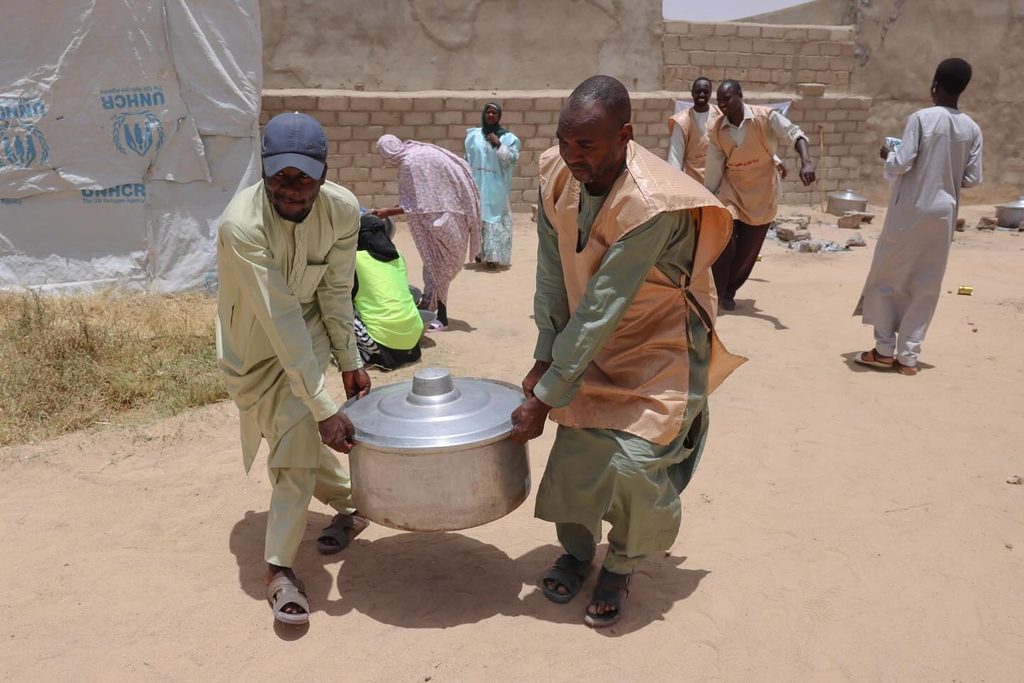
But that did not mean there was no organization. People knew who could do what.
Responsibilities were distributed according to professional skills,
geographic proximity, availability and urgency. Older volunteers
carried particular authority because they had accumulated experience;
younger volunteers learned from them.
The arrangement was informal. But it was not unorganized.
Emergency Response Rooms (locally organized civilian networks that
coordinate emergency food, health care, evacuation and other essential
services) and other civilian networks in Sudan are often described in
humanitarian language: communities feeding communities, transporting
medicine, evacuating the wounded and filling gaps left by the collapse
of public services and the difficulty of international organizations
reaching people.

That description is accurate, but it does not tell the whole story.
The more consequential question is: What did people learn while doing
all of this?
They learned how to mobilize resources without an institution behind
them. How to decide which needs were most urgent. How to match people
to tasks. How to negotiate movement through territories controlled by
different armed actors. How to manage disagreements without allowing
them to destroy the network. How to move money and information across
front lines. And how to transfer knowledge to someone else before the
person who possessed it was killed, arrested or forced to flee.
Survival became a school of organization. But this school did not
begin from nothing.
Before the war
Sudan already had traditions of collective action, including nafeer (a
Sudanese tradition of collective voluntary labor in which people
mobilize together around a shared need). The resistance committees
(decentralized, neighborhood-based civilian groups that became a major
force in Sudan’s 2018–19 revolution) that emerged during the
revolution also developed forms of neighborhood-level organization
based on trust, horizontal coordination and collective action.
After the revolution, parts of this infrastructure evolved into Change
and Services Committees (local community bodies that organized basic
services and neighborhood affairs), which in different areas organized
aspects of everyday life, from bakeries and cooking gas to other local
services. These were organized bodies. In some places, they had
defined responsibilities, documents and official stamps. Their members
accumulated practical knowledge about managing the affairs of their
communities.
So when war came, civilians did not begin from zero.
There was already an infrastructure that had learned how to turn
political trust into everyday administration.
The experience of Gezira State reveals something even more striking.
When the Rapid Support Forces, or RSF, a powerful paramilitary force
that the U.N. and U.S. found has committed acts of genocide, took
control of Gezira on Dec. 18, 2023, local government effectively
disappeared from areas under their control. Less than a month later,
on Jan. 16, 2024, the governor of Gezira issued Decision No. 1 of
2024, dissolving all Change and Services Committees in villages,
neighborhoods, rural settlements, markets and industrial areas.
The decision did more than dissolve them. It instructed local
executive officials to inventory and take possession of the
committees’ fixed and movable assets, documents, property and official
stamps, and to freeze their bank accounts until new caretaker
committees could be formed.
There was something revealing about that detail: Even the stamps were
part of the authority the state wanted to reclaim.
But the committees that the governor had ordered dissolved were still
on the ground, while the authority issuing the order was absent.
The committees’ response, in essence, was a simple question: If you
have dissolved us, come into the state you left and take the stamps
from us.
Six days later, on Jan. 22, the Fifth Infantry Division command of the
Rapid Support Forces issued its own decision, stating that it was
“renewing confidence” in the Change and Services Committees and
instructing them to continue performing their duties toward citizens
across the state’s localities, neighborhoods and villages.
The contradiction could hardly have been clearer.
The state, absent from the territory, ordered the civilian bodies
operating there to disappear. The armed force that controlled the
territory found itself facing an existing civilian infrastructure
performing functions that military control alone could not perform.
An armed force can enter a city and declare control within hours. It
does not automatically know who needs medicine, who has the key to the
bakery, who can operate a water station, which families need
assistance, or who can safely move between neighborhoods.
Here it becomes apparent that controlling territory militarily is not
the same as possessing the knowledge required to govern life within
it.
The Change and Services Committees were not just a humanitarian
response that emerged when the war began. Before the war, they had
already accumulated experience organizing everyday services. What
looked during the war like the sudden emergence of civilian networks
was, in many places, a shift from one function to another: from
organizing bread, gas and local services during the revolutionary
period to organizing food, water, medicine and evacuation during war.
The infrastructure did not disappear when the state did. The mission changed.
The experience of a group of water engineers led by a man named Bakri
illustrates the difference.
At the beginning of the war, the group tried to keep existing water
stations operating. But as the fighting continued, fuel and spare
parts became harder to obtain, while insecurity made maintaining
centralized infrastructure increasingly difficult. So they improvised.
They organized ways to bring water directly from the Nile, sometimes
using donkey carts carrying large barrels. They located wells that had
been abandoned for years and organized their reopening. When some
families could not collect water themselves, volunteers delivered it
to them.
Teachers did something similar. A group led by Saif began operating
schools at limited capacity after the war dragged on and children’s
behavior became increasingly aggressive and distressed.
They were not trying to restore a normal academic year or guarantee
promotion from one grade to another.
They were creating child-friendly spaces where children could learn,
play and recover some sense of routine, while reducing the educational
and psychological damage of prolonged war.
The same pattern appeared in medicine, evacuation and information.
Volunteers who had never received formal emergency-response training
learned how to respond to airstrikes and artillery fire, how to
protect women and children, how to organize safe departures, and how
to move patients whose required treatment was unavailable in conflict
areas.
Some became known to armed groups because their work required repeated
negotiation with them. Sometimes that familiarity helped them pass
checkpoints or move patients with fewer risks.
When neutrality becomes suspicion
But that knowledge created another danger. The more successfully
civilian networks kept life going, the harder it became for armed
actors to regard them as non-political.
In one town in Gezira, a group of young women working in medicine
faced precisely this dilemma after the RSF took control and the
hospital closed. They managed to enter the hospital and remove
laboratory equipment, medicines and other essential supplies. They
then began treating patients in secret.
They feared being forced to treat RSF fighters. But they also feared
what would happen if the army returned and interpreted that treatment
as evidence of collaboration with the RSF.
They continued working secretly for months. Eventually they were
discovered and arrested, before being released after it became clear
that they did not represent a political or military threat.
Their experience reveals a central contradiction of civilian life
during war: You can decide to serve everyone. You cannot decide how an
armed actor will interpret that service.
A surgeon I interviewed in Gezira lived through the same contradiction
in a more brutal form. She was trying to keep medical care available
to civilians. She treated everyone, including wounded RSF fighters.
According to her account to me, RSF members assaulted her inside the
hospital after one of the fighters she had operated on died. Her
13-year-old daughter was then sexually assaulted.
She did not tell me what happened simply as a personal story. She was
warning me to leave.
I was in Gezira myself during this period. I was among those working
to keep hospitals functioning and civilian services going. I saw how
quickly humanitarian work could be viewed as politically motivated.
This is where the language of humanitarian neutrality reaches its
limits. In a war in which each side seeks not only to control
territory but also to define the meaning of every action within it,
even neutrality can acquire political meaning.
The problem is deeper than civilians being trapped between two armed
forces. The war itself can appropriate the meaning of civilian action.
A doctor treats a wounded person because the person is sick. A fighter
sees assistance to the enemy.
A network moves a family because the family is in danger. An armed
actor sees suspicious movement.
The space between humanitarian action and political action becomes so
narrow that separating the two can become almost impossible.
Knowledge that survives
And yet the networks continued to grow.
New volunteers joined. Donations from Sudanese abroad continued.
International organizations provided limited support in some areas. In
parts of Gezira, volunteers running medical facilities sometimes
coordinated with Médecins Sans Frontières.
But the most important development was less visible. The networks
began reproducing knowledge. The older generation knew they might not
survive. Volunteers were being killed, arrested and displaced. So
those with experience began teaching younger people what they knew.
This was more than training. It was a relationship of respect,
mentorship and apprenticeship. And the reason was practical and
brutal: If one person died, their knowledge should not die with them.
This changed the nature of the networks. A volunteer who distributes
food to a neighborhood is practicing mutual aid.
But a network that can replace that volunteer, transfer the knowledge
required to continue the work and survive the disappearance of its
original organizers is demonstrating something closer to institutional
capacity.
It is not an institution. But it is a capacity.
That distinction matters because we usually recognize institutions
through their visible forms: offices, regulations, budgets, job
titles, salaries and chains of command.
But perhaps institutions begin before all of those things. They begin
when knowledge becomes transferable. When responsibilities can be
redistributed. When a collective practice can survive the
disappearance of the person who started it. When people know what to
do without waiting for someone to tell them.
This is also why it is difficult to describe these networks simply as
temporary substitutes filling a vacuum until the state returns.
The vacuum itself changed the society inside it.
People who entered the war knowing how to organize a neighborhood
learned how to manage networks stretched across displacement, fear and
military control.
The volunteer who began by distributing food learned, over time, how
to manage money, information, risk and relationships with armed
actors.
The doctor who opened a hospital door had to think about security,
neutrality and evacuation, not only medicine.
Even disagreements within networks became part of the learning: how to
disagree without breaking the network, and how to place people’s
immediate safety above personal conflict.
The war was not building institutions in the conventional sense. It
was building people who knew how to create organization under
pressure.
The limits of resilience
But the answer cannot be romantic. These networks cannot replace the state.
They can distribute food and medicine, restore access to water,
organize emergency medical care and create educational spaces. They
cannot indefinitely operate a national electricity grid, maintain
complex pharmaceutical supply chains or guarantee public safety.
Nor are they equal.
Some neighborhoods have doctors, engineers and strong diaspora
networks. Others have far fewer resources. Funding can run out.
Volunteers can burn out. International support can bring bureaucratic
requirements that alter the character of informal work.
These networks are therefore not proof that the state is unnecessary.
They are proof that state capacity and social capacity are not the
same thing. And that distinction becomes even more important when
military control changes.
In areas retaken by the army, some volunteers fled. Others were
arrested or killed after being accused of collaborating with the RSF.
Sometimes the basis for suspicion was simply that they had continued
providing services while the RSF controlled the area.
The same act that had once been an act of survival could acquire an
entirely different political meaning when the person at the checkpoint
changed.
Yet the practices themselves did not necessarily disappear.
The takiyyas continued, often under different people. The faces
changed because the people who had built the networks had been killed,
imprisoned or displaced. But the practice survived.
This may be the most politically revealing fact about Sudan’s civilian
networks during the war.
The war did not simply create a vacuum where the state had been. It
forced people to learn what could be organized inside that vacuum.
They learned from those they trusted. They learned how to distribute
scarce resources. They learned how to negotiate with armed actors
without becoming armed themselves. They learned how to make collective
decisions without formal authority. They learned how to teach someone
else before they disappeared.
And perhaps they learned something more important than any service
they provided: The capacity to organize collective life does not
always come from the center.
For decades, the state was treated as the basic infrastructure that
made public life possible.
The war shattered that assumption in places where the state could no
longer provide food, water, health care, education or security.
People did not respond because they had decided to build an
alternative political system. They responded because someone had to
cook. Someone had to find water. Someone had to treat the wounded.
Someone had to get children off the streets. Someone had to negotiate
passage.
But repeated acts of necessity accumulated into something larger than
necessity. They accumulated political knowledge.
And this is why rebuilding Sudan after the war cannot simply mean
restoring the institutions that stopped working.
Sudan will need public institutions capable of functioning. No
volunteer network can replace the state indefinitely, and asking it to
do so would only turn another form of resilience into another form of
abandonment.
But rebuilding the state without recognizing what society learned in
its absence would be another kind of failure.
The question is not whether takiyyas should become ministries, or
whether Emergency Response Rooms should become permanent government
agencies.
The question is whether the people who learned to organize life
without formal authority will be treated merely as beneficiaries of
reconstruction — or as people who acquired something the postwar state
urgently needs.
Because the most important legacy of these networks may not be the
meals they served, the wells they reopened or the patients they
treated. It may be the knowledge that accumulated among them: That
authority can be exercised without office. That responsibility can be
distributed without bureaucracy. That trust can function as
infrastructure. That institutions can disappear without the capacity
of society to act disappearing with them.
The people who built these networks were not trying to design a new
political system. They were trying to survive.
But wars can produce political knowledge without anyone intending to produce it.
And perhaps the central question facing Sudan after the war is not
simply whether the state can return to the places from which it
disappeared.
It is whether it can return without pretending that the society
waiting for it is the same society that existed before it left.
Perhaps the task after the war is not to return society to the state
that existed before the war, but to rebuild the state around the
knowledge that society was forced to produce when the state was gone.
This article was first published by Waging Nonviolence