


News
Michael DeAngelo and Liam Karr
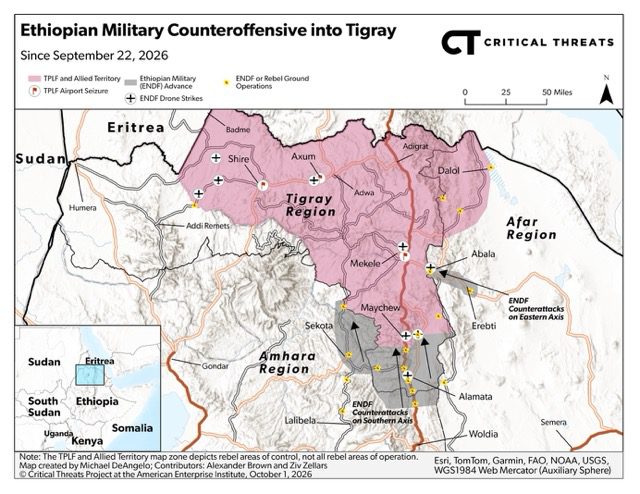
The Ethiopian military (Ethiopian National Defense Forces, ENDF) has largely repelled the rebel offensive in northern Ethiopia and launched a counteroffensive consisting of three different lines of advance toward the Tigray People’s Liberation Front (TPLF)–controlled regional capital, Mekele. Afar and Tigrayan rebel forces initially made gains in northern Afar region, where they are likely aiming to consolidate control over a buffer zone and rear supply networks along the Eritrean border.
The Afar Revolutionary Democratic Unity Front (ARDUF/Ugugumo) and the Tigray Defense Forces (TDF, the TPLF’s military wing) captured Abala—a district capital approximately 30 miles east of Mekele, the Tigray regional capital—on September 22. The rebel forces then took Erebti—a district capital 75 miles east of Mekele—on September 27 from federally backed forces, including the Tigray Peace Force (TPF), an anti-TPLF Tigrayan rebel group.
Multiple open-source mappers and pro-rebel sources reported that rebel forces also captured Dallol district, which is 115 miles northeast of Mekele on the Eritrean and Tigray borders, on September 29. The rebels reportedly controlled at least three—and possibly up to six—of the eight total districts in Afar’s northernmost zone by September 30, based on unverified reports from Al Jazeera and Agence France-Presse.
The ENDF has launched successful counterattacks to reverse rebel gains to the east, however, opening a line of advance toward Mekele. The ENDF reportedly retook Erebti on October 1. The recapture of Erebti precludes a rebel advance to cut the strategically important Ethio-Djibouti highway (A1), which is 225 miles southeast of Erebti, via a secondary road that links to the A1 near the Afar regional capital, Semera. The Ethio-Djibouti highway connects Ethiopian domestic markets to the port of Djibouti, which handles over 90 percent of Ethiopian imports and exports. The ENDF reportedly continued its advance from Erebti and took Abala on October 1, completely undoing rebel gains on the secondary road.
The ENDF has simultaneously halted Amhara rebel and TDF advances in the northeastern Amhara region and counterattacked north, advancing on main roads toward Mekele. The ENDF repelled an initial Amhara Fano National Movement (AFNM) and TDF advance south toward Woldia—the capital of the North Wollo zone and a crossroads town connecting several major highways in Amhara—near Kobo, which is 30 miles north of Woldia, by September 25. The ENDF and TPF then began advancing north into Tigray’s Southern zone via the A2 highway, which connects Woldia to Mekele. The federal forces captured several towns along the A2 by September 30, including Alamata and reportedly including Korem, the latter of which is approximately 60 miles north of Woldia and 100 miles south of Mekele. The ENDF has since continued its advance and clashed with the TDF on the A2 between Korem and Maychew, which is 25 miles north of Korem, on September 30. ENDF forces have also advanced on a secondary road linked to the A2 in a flanking or bypass maneuver and reportedly captured Mekoni, which is approximately 10 miles east of Maychew, on the night of September 30 to October 1.
The ENDF has advanced quickly toward Mekele through difficult terrain on the A2, although potential challenges remain. The stretch from Kobo to Alamata is on a plain, but it becomes mountainous on the approximately 115-mile stretch from Alamata to Mekele. The ENDF has already advanced approximately a quarter of the distance between the two localities in three days. Reports from an open-source mapper and a conflict reporter suggest that the TDF has tactically withdrawn from positions along this stretch of the highway, presumably to fortify other positions surrounding the A2 and Mekele, however. The ENDF’s simultaneous advance on the secondary road linked to the A2 indicates that it is also seeking to consolidate control of both routes before a final approach to Mekele.
The ENDF has also opened another alternative line of advance to Mekele on a secondary road west of the A2. The ENDF retook Sekota, which is 70 miles west of Alamata, on September 27 after the AFNM and TDF had entered the town on September 25. The ENDF and TPF then reportedly advanced 40 miles north to capture Abergele, which is on the Tigray regional border approximately 60 miles southwest of Mekele, on September 28.

Rebel actions
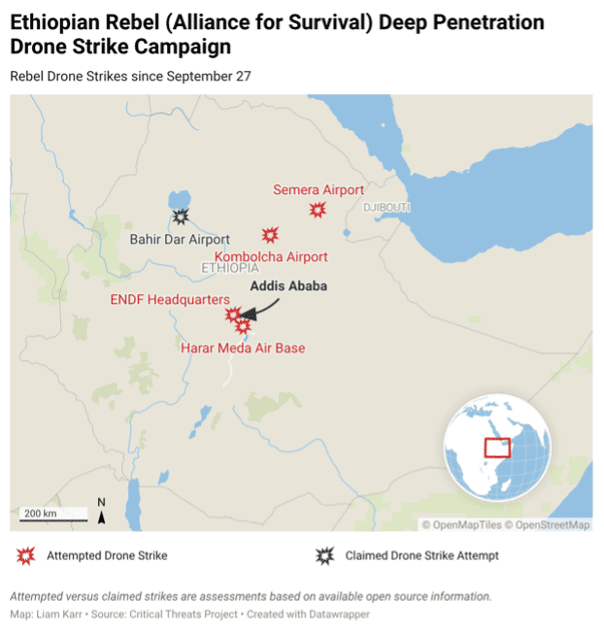
Rebels have launched a deep penetration drone strike campaign targeting key federal facilities in and around Addis Ababa, the Ethiopian capital, likely to degrade and stretch Ethiopian assets and symbolically demonstrate the rebels’ ability to expand the conflict across the country. Rebels launched numerous drone strikes targeting air facilities across Ethiopia on September 27. Rebel drones reportedly targeted Harar Meda Air Base in Bishoftu airport in the Oromia region, which is the Ethiopian Air Force headquarters approximately 35 miles southeast of Addis Ababa.
The strikes allegedly killed multiple ENDF soldiers and possibly damaged airport assets according to satellite imagery analysis by open-source analyst Rich Tedd and separate reporting from investigative Egyptian outlet Mada Masr, although CTP could not independently corroborate any damage in its own review of low resolution satellite imagery. Strikes also reportedly targeted the Kombolcha airport near Dessie in Amhara and the Semera airport in Afar on September 27. Federal authorities temporarily halted airport operations at Kombolucha, and videos on social media claim to show firefighters putting out a fire at the airport, while low resolution satellite imagery shows possible damage at the Semera airport.
Pro-rebel media claimed that the Ethiopian Peoples’ Forces Alliance for Survival (Alliance for Survival) conducted the strikes and also targeted the Bahir Dar airport, although CTP could not confirm any damage or disruption to airport activity. Lack of damage confirmation could mean that drones either missed their target, were intercepted, or were too small to register visible damage on satellite imagery.
Suspected drone strikes then reportedly targeted multiple locations in Addis Ababa, including the ENDF headquarters, on the night of September 30 to October 1. An anonymous security source told Mada Masr that Ethiopian air defenses had downed suicide drones attempting to target the ENDF headquarters and possibly the 24th Infantry Division headquarters in the Kirkos district. The Ethiopian National Intelligence and Security Service subsequently suspended drone flights around Addis Ababa. Rebel-linked sources told Reuters that the Alliance for Survival had conducted the strikes. CTP was unable to corroborate any visible damage in low resolution satellite imagery.
The campaign likely aims to degrade and stretch ENDF assets. All the strikes have targeted military installations. The first wave of strikes particularly targeted air bases, presumably to degrade ENDF air capabilities, which played a decisive role in the Tigray war. A former Ethiopian intelligence official told Mada Masr that deep-penetration strikes also likely aim to tie down ENDF assets outside of the main battlefields in northern Ethiopia.
This campaign also likely aims to symbolically demonstrate the rebel coalition’s capabilities and reach across the country. The strikes are the first well-documented instances of any of the rebel coalition members conducting drone attacks. Addis Ababa and Bishoftu are within Oromo Liberation Army (OLA) areas of operation, Bahir Dar and Kombolcha are within AFNM areas of operation, and Semera is closest to AFNM, ARDUF, and TPLF areas of operation.

TPLF
The TPLF is facing more internal discord now than it did during the first Tigray war, which is undermining its current war effort. The TPLF previously took advantage of popular discontent among Tigrayans toward the federal government and its Eritrean and Amhara ethno-nationalist allies to advance the war effort in the Tigray war from 2020–22. The TPLF leadership publicly presented a united front, and there were few defections from the TPLF. Former high-ranking Tigrayans in the Ethiopian security forces formed the TDF in coordination with the TPLF leadership. The TDF then mounted a mass mobilization campaign, building its forces potentially up to 250,000 fighters, although Reuters reported that the TDF forcibly recruited fighters as the war went on.
The fallout from the first Tigray war and the ensuing 2022 Pretoria peace agreement sparked divisions within the TPLF and among Tigrayans that are undermining the TPLF’s current war effort. TPLF hardliners, led by TPLF head Debretsion Gebremichael, opposed the Pretoria agreement from the outset and worked to undermine Pretoria agreement supporters within Tigray, resulting in several high-ranking Tigrayan officials defecting to the federal government. Former Tigray Interim Administration (TIA) head Getachew Reda and senior TDF and TIA official Tsadkan Gebretensae left the TPLF in early 2025 and aligned themselves with the federal government after the TPLF deposed Getachew’s administration.[31] Getachew’s successor, former TDF head Tadesse Worede, resisted TPLF efforts to nullify the TIA and reinstate the pre-Tigray war regional government in May 2026, leading the TPLF to depose him as well.[32] The TPLF reportedly arrested Tadesse and three other TDF officials shortly after the ongoing war broke out on September 22.[33] Tigray police commissioner Gebre Dilla also reportedly defected to the federal government on September 23.[34] The TDF has also relied on mass conscription since June to replenish its ranks amid greater popular reluctance to join the TDF.[35] The TPLF has dealt with rising dissatisfaction among Tigrayans from its governance shortcomings since 2022.[36]

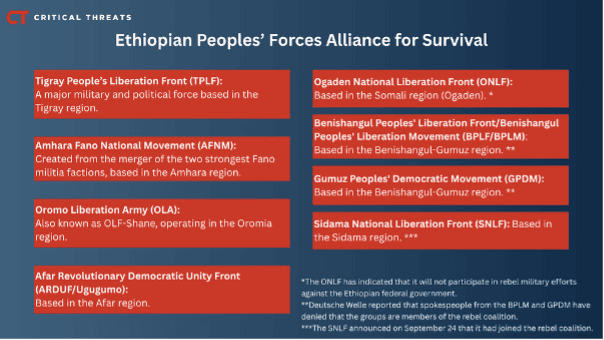
The Alliance for Survival has also more broadly demonstrated a lack of cohesion across all members since the war resumed, highlighting the initial limitations of the rebel coalition. Three smaller members of Alliance of Survival have indicated that they will not contribute to the rebel military effort.[37] A spokesperson for the Ogaden National Liberation Front (ONLF) stated in an interview with Al Jazeera the ONLF only supports the Alliance for Survival’s political goals, not its military aims.[38] Deutsche Welle Amharic also reported that spokespeople from the Benishangul Peoples’ Liberation Movement and the Gumuz Peoples’ Democratic Movement separately denied that their groups were members of the Alliance for Survival at all.[39] The Sidama National Liberation Front, which is a minor rebel group based in the southern Ethiopia’s Sidama region, announced on September 24 that it had joined the Alliance for Survival, however.[40]
First published by Crital Threats