1000 days of war in Sudan:
How the kindness of strangers kept a country alive. We are as made of ruins and loss as we are made of solidarity and resilience
By Samah Fawzi
A jug of water is the memory I would choose to keep if all other wartime gifts had to be forgotten.
It was the third week since the war broke out. I was in the city of Bahri, Khartoum, one of the first areas affected by the conflict. It did not take long for stray bullets to reach us, nor for the power and water supply to be cut.
One morning, I woke up nursing a thirst that could quickly tip into panic, and an urge to leave the neighbourhood where I was.
I went down my street to find water. The nearest place with running water was Ahmed Gasim, a well-known paediatric hospital in the area, but reaching it meant crossing swaths of RSF men – something I was not willing to do. I needed another source.
It was a quiet morning, except for the distant artillery; the street was almost deserted, and all the shops within sight were closed.
I spotted two men in front of a house across the street. It seemed they had spent the night there. I assumed it was in an effort to offer whatever protection was possible in those days for their house and family.
I crossed over and asked them if they had any water. They exchanged a glance I understood all too well. You see, water was the most precious thing at that time.
Nevertheless, they acquiesced with a mix of resignation and generosity. One of them went inside the house and brought me a jug of water, less than half full – only a few gulps really. But I knew it was the best they could offer. I took the jug and crossed back.
A white SUV then emerged from a side road. This was before most citizens’ vehicles were looted, before everyone had fled. I waved it down and asked the driver if the road ahead was clear for movement. He said the way he came was safe.
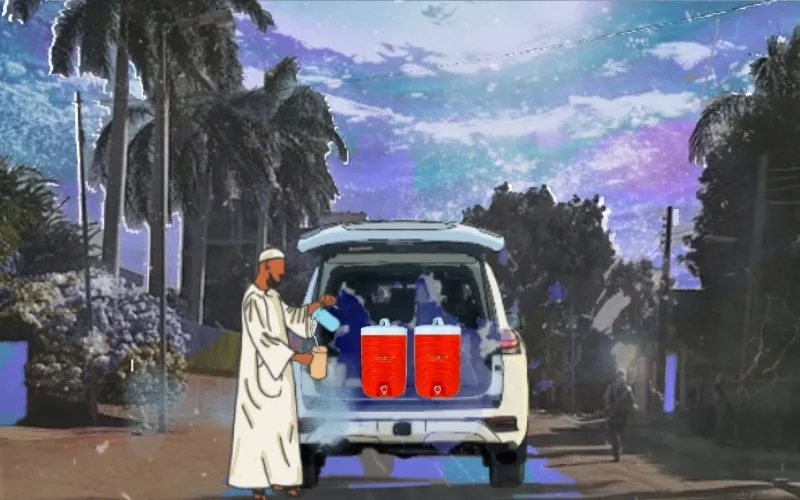
The driver was a middle-aged man in a white Sudanese galabiya and a hat. He noticed that I was carrying a water jug. He asked me if I was looking for water. I said yes. He got out of his car and opened the trunk. I saw a large water container. It appeared that he, too, had been searching for water. He filled my jug to the brim and then some more. I thanked him. We drank and filled a bottle for the road. Then I took the jug back to the two men across the street, with more water in it than what they had given away.
On that same day, after learning that the road ahead was clear, we went out to find a bus that would take us from Bahri to Wad Rawa in Al Jazirah state.
On the way to the bus station, I was confronted with what a war could do to a city. We passed through an area said to have witnessed a battle the day before: buildings on both sides of the road were gutted with bullet and missile holes; two or three technicals – combat trucks – lay burned and broken on the roadside; shattered glass and artillery pieces adorned the asphalt in a grotesque embrace; and shops had already been broken into too, the looting well underway.
There were people like us everywhere, walking and dragging suitcases. An evacuation convoy passed by with large flag-marked SUVs carrying foreign nationals inside, some wearing ordinary attire, others in tactical gear holding guns. A few Sudanese civilian cars were tailing behind. It was a wretched sight to witness; because whoever granted that convoy safe passage could have granted us peace, but chose not to.
In Wad Rawa, we found temporary shelter with distant relatives. It was my first time in the village, and my first time visiting the house where I would spend the next two months.
There, I learned that people do not say “How are you?” in the singular when they meet and greet; they ask it in the plural. Life was rooted in the collective, and people made plenty of very little.
At meal times, doors would open, and neighbours – who were also relatives – would come carrying trays of food they had prepared in their own homes, honouring the displaced, who were never referred to as such.
It occurred that during my time in Al Jazirah state, I needed to procure some life-saving medicine. A single vial of that medicine would travel between cities and villages, Wad Madani and Al Gunaid, to finally reach me in Wad Rawa. Friends and colleagues would become the lifeline.
Once the vial reached Wad Rawa, it then took a life of its own, rotating among the neighbourhoods’ houses. You see, electricity was unstable, and ice had to be bought from the market, but the insulin had to be kept cool. So it would be stored in whatever house had a small power generator, or the one that had ice overnight.
I left Wad Rawa learning how to say “How are you?” in the plural. I left having learned that survival is a collective act.
The war had entered its third month, and we believed that the kind relatives who had given us shelter had given enough. The chances of the war being “The Thirty Days’ War” or “The Hundred Days’ War” were becoming slim.
We needed a more permanent residence of sorts, and Karima would become that.
My reluctance was not because I had anything against Karima, but because the act of going further north and further from Khartoum, my city, meant accepting that the war itself was not going anywhere. It implied a reality that I did not want to confront.
We went anyway.
Karima proved to be welcoming, its people exceedingly kind. There was the relative who did not own much but still took out garments from her wardrobe and shared them with us; the relative who brought us firewood to burn in the traditional charcoal burner, the “Mangad”, when winter arrived; the shopkeeper in the town market who would let me sit and work using his internet connection in his 2×1 meter shop without charging me anything in return; the market vendor who would give me a discount because we were Nas Alkhartoum, the arrivals from Khartoum.
They were resilient when psychological warfare was being waged against them, the RSF labelling their state as the “next target”.
Praise be to the heavens that no fighting reached Karima, through RSF drones struck nearby. They targeted vital power infrastructure in the nearby town of Marawi throughout 2025, causing many areas in Northern state to descend into darkness for months on end.
Still, resilience is what stands out here. People were resilient when their town experienced surges of displaced people – who they never referred to as such – and supported them with communal efforts. People were resilient when their livelihoods were interrupted by blackouts and connectivity outages. And they were resilient when psychological warfare was being waged against them, the RSF labelling their state as the “next target”.
I admit that I was not entirely engaged with others during my time in Karima. It is challenging to make a home out of a series of new places and a chain of new beginnings. It is easy to slip into a state of disequilibrium and perpetual waiting when the anchors of life are continuously fluid.
But occasionally, amid the turbulence of displacement and within the echoes of loss, we are given the choice to witness the gifts that we have been given.
Before 2023, my money-borrowing history was rather slim, mostly limited to my sister in my younger years. By contrast, I have borrowed money four times since the war began. Once, the sum was used to start a remote educational programme, which I have now completed. Another time, it covered travel expenses to a new country where I had found employment – employment that was quickly lost due to the stop-work orders of You-Know-Who.
As much as I am thankful to my creditors, there is a different story that I want to share with you here.
It is about a woman who handed me a wad of cash on a semi-deserted road somewhere in Al Jazirah state.
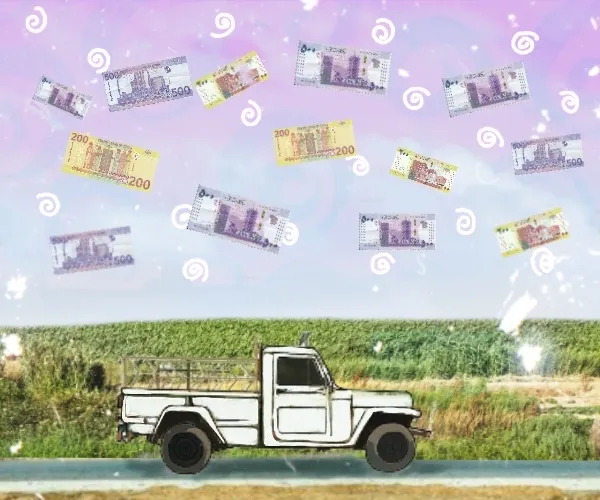
It was on a trip to procure medicine from a village not too far away. It happened that I was not familiar with the roads and under-estimated the money I would need to complete the trip. And it happened that I met this woman and her family of four riding on their old and tattered pickup truck.
I had not asked for money nor for a ride, but for directions; directions, money, and a ride were what that woman gave me. Without me explicitly uttering my distress or bewilderment, the woman had intuitively understood and was moved to action.
I accepted her offer reluctantly. And I am glad I did. In taking her money, there was no more room left to evade my reality, not in the life I was living right then and there, and definitely not in the future hurling upon us with minimal clarity.
I am forever grateful to that woman and her family of four. First, I completed my trip successfully because of her contribution. Second, she helped disassociate me from unnecessary claims of loftiness that I held on to from my life prior to the war.
The war still rages on. We are as made of ruins and loss as we are made of solidarity and resilience. We remain our own greatest witness, inflictor, and saviour, in one of the longest and most paradoxical tales of a nation’s making.
I might not be able to knock on every door and prostrate in gratitude for everyone who showed me kindness in the most testing of times, but I can write these stories and share them with those who are willing to listen.
This story was first published by the New Humanitarian
Illustrations by Azza Elhussien.