
Koert Lindijer has been a correspondent in Africa for the Dutch newspaper NRC since 1983 to 2026. He is the author of four books on African affairs.
Mohamed Hamdan Dagalo, also known as Hemedti, had barely become a government supported warlord against Black African rebel groups in North Darfur when he used his position to pursue his own interests. In 2006, the future leader of the Rapid Support Forces (RSF) went hunting for a Zaghawa rebel commander who had stolen camels from him three years earlier. When Hemedti found no trace of the herd, he called in Sudanese Air Force aircraft to carry out attacks on the Zaghawa. This conflict of interests, both his own and the government’s, perfectly characterizes Hemedti. This allowed him to rise from school dropout to camel trader, from ruthless warlord to a contender for the Sudanese presidency.
Hemedti is part of the toxic legacy of President Omar el-Bashir (1989-2019), who was ousted in a popular uprising in 2019. Hemedti belongs to the Reizegat Arab ethnic group, was born in neighboring Chad in 1975, and moved to the western Sudanese region of Darfur, where he worked in the cattle trade. He dropped out of high school and was recruited into the Janjaweed Arab militia, Bashir’s auxiliaries in a war against African rebels. That 2003 war in Darfur led to a quarter of a million deaths and thousands of scorched villages and towns, almost exclusively Sudanese of African descent.
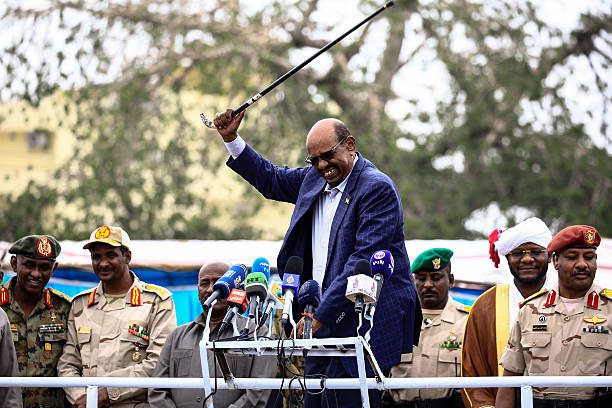
Bashir created a monster with the Janjaweed in remote Darfur. In 2013, he transformed the Janjaweed into the RSF and incorporated the militia into the national army. After the war in Darfur in the early 2000s, the RSF subsequently helped government forces combat uprisings in the Nuba Mountains and Blue Nile regions, and as early as 2013, they assisted in suppressing popular demonstrations in the capital. From 2016 onward, the government also deployed them to apprehend migrants along the borders, a policy initiated by a European Union aid package to Sudan to curb migration. Ten thousand RSF fighters fought as mercenaries with a Saudi-led coalition in Yemen, earning Hemedti considerable income and prestige among Arab countries in the Middle East.
The tall man with the sarcastic smile of a mischievous child wasn’t content with leading auxiliary troops but secretly worked to build his own power. He cobbled together various armed groups within the RSF and recruited fighters for it throughout the Sahel countries. Using gold from his Jebel Amer mine and the smuggling of drugs, weapons, and stolen cars, Hemedti built a financial empire comparable to that of the national army, which controlled eighty percent of the economy. Through a combination of business and violence, he made the RSF wealthy, autonomous, and almost untouchable.
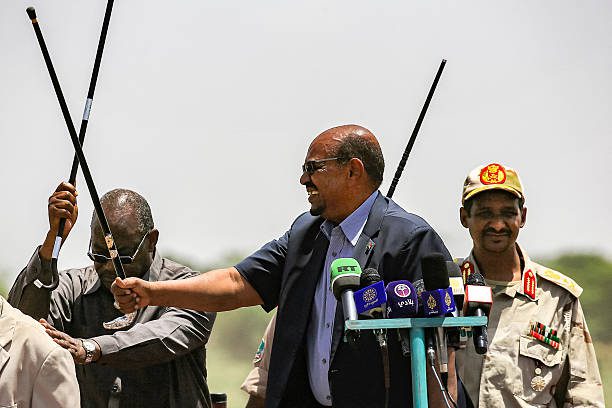
Bashir saw Hemedti as his protector, but the RSF leader turned against his creator and helped overthrow him in 2019. Hemedti’s post-2019 position as vice-chairman of the country’s interim governing council under Bashir’s successor, President Burhan, was not that of a subordinate; He had by then become an influential shareholder in the competing patronage networks that have held Sudan in their political and economic thrall since before independence in 1956. These trade networks historically operated primarily along the Nile River between Khartoum and the city of Atbara downstream, where the Nile begins to meander and is no longer navigable. They dominate Sudan, much to the chagrin of remote and marginalized regions such as Darfur and Hemedti. By 2023, his RSF was better armed and financed than the corruption-ravaged government army. Now Hemedti could engage in combat with Burhan.
Chaos and impunity are part of the RSF, at the expense of civilians. The militia shot at unarmed protesters in Khartoum, tied stones to their feet, and threw them into the Nile. The RSF fighters rape young women in their barracks and tie opponents behind their backs and dangle them from tree branches. Looting is their specialty. During the war in Darfur earlier this century, the Foro Burunga border post was sometimes called the “anus of the conflict,” because many stolen goods left the country from here to Chad. The loot is now transported through Libya’s southeastern region, an area controlled by the Libyan warlord Haftar.
Portraying Hemedti as merely a criminal warlord would obscure the underlying causes of the conflict in Darfur. He presents himself as a fighter for a more pluralistic Sudan, freed from a religious dictatorship of fundamentalists and with more rights for peripheral areas. The climate crisis of the past half-century has hit Darfur particularly hard, but the power center in Khartoum has ignored the disaster.
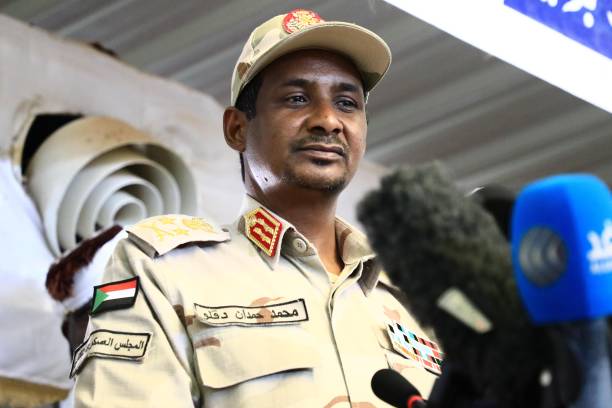
The war in Darfur has been called Africa’s first environmental war. Herders and farmers are fighting over dwindling resources; the region can no longer withstand population pressure. Once, sufficient water remained in the creeks, but now even the basins cannot retain enough water. The Sahel, of which Sudan is a part, is one of the fastest-warming places on earth – 2 degrees warmer than a century ago.
Traditionally, farmers and nomads made agreements among themselves about access to the land. Farmers granted nomads the right to eat the dried stalks of millet after the harvest. But since the war in the early 2000s, they have been burning the dried reeds in their fields to keep the cattle herders away. Hemdti further fueled this distrust between farmer and nomad by attacking camps of displaced African farmers around El Fasher in recent months and killing hundreds of residents. Thus, a racial divide between Arabs and Africans is becoming increasingly clear in the conflict. Ethnicity and racism are not the root of the conflict. It lies in an embedded culture of political violence in Sudan, in which people like Hemedti thrive.
This article was first published in NRC on 17-11-2025